

Finding Our Kind
Talisman from the dead

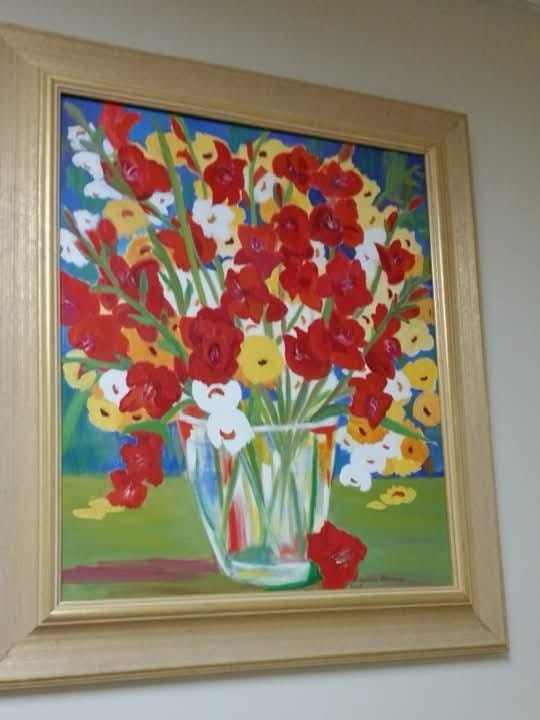
When I was at St Catherine's, struggling to get strong enough to get out of bed, I could see this painting on the wall across from my door. I asked the CNA who painted it. She said she couldn’t read the name, but she’d find out.
When I was strong enough to get out of bed and out of the room on my own, I could read the signature in paint well enough. It said “Goodman”.
Bill and Edwina Goodman were prominent figures in my life from childhood. Rarely does a week go by that I don’t mention Bill in one of my Mississippi Camelot stories. Edwina was huge, too.
Last year, Galloway was auctioning off some donated art. They had a small painting by Edwina Goodman. “How has it gone unsold all these years?” I thought. The colors were more muted than she usually painted with, which made it more valuable to me. I wanted it so badly, but the walls in my apartment were more than full already. The price was a steal, literally, so I gave it to Millsaps.
Growing up, art lessons were my family’s only concession to the talents God had given me, rather than the business and community leader they, and everyone else, including Bill Goodman, were grooming me for.
Once, at a dinner party. I was helping Johnny Gore serve drinks, but not sampling them. (Yeah, right.) Mrs Goodman cornered me to talk about one of our classes. I was sixteen at best.
My dad said, “Hell, Boyd spends more time with Edwina than Bill.” The men got a kick out of that.
Jackie Meena said, “Yeah, well Boyd’s more fun,” and all the wives laughed.
From this and other incidents, I developed a reputation as an ambassador to the wives.
Once, I signed up for a figure studies class with Bebe Wolfe. Mrs Goodman, Meena, and Manning also signed up. Rowan Taylor was recently divorced and recently dumped by his paramour. I think he was looking for connections with people his age who weren’t happily married, so he could adjust to his new life. Signing up for the course, I’m not sure he knew what “figure studies” meant, but I did, so did the ladies.
The first model came out. Thin and pale, he looked like a cadaver, which made him kind of perfect for the task. When the robe dropped, the ladies and I got to work, but sitting next to me, I could hear Rowan take a deep breath and sigh, “uh boy…” under it.
The next day, Rowan dropped that class and joined one about how to read Eudora Welty. It was there he met a Spunky Yankee writer who became his wife, teaching the course. Her name was Suzanne Marrs. As Paul Harvey used to say, now you know “The Rest of the Story.”
If Bill had been alive when I was in recovery, he would have said, “Why are you in bed? Don’t you have work to do?” and I would have gotten up. If Mrs. Edwina were still alive, she would have brought coffee and talked me into it. Either way, I was getting up.
The nurses told me this was one of Mrs. Edwina’s last paintings before she passed away. Hearing that, I studied the brush strokes for differences between this painting and the artist I knew. Most people ignore brush strokes; artists know they have meaning. I can't paint as well as I write, but I'm a polymath, which sometimes makes me impossible to be around. When I'm working, just don't try.
I went looking for this picture because my protégée said she knows Mrs. Edwina’s grandson. His style is very different from his grandmother, but i can see similarities. Needless to say, I'm a huge fan.
I realize now this is a Mississippi Camelot story, one of the better ones. I’ll move it to Substack when the sun comes up.
I’ve been talking to Mary B about how the first play I did for Lance Goss was “Orpheus Descending.” I got to fire a gun and kill people. When Millsaps brought the theatre department out of the mothballs, hiring My Boy Sam to do it, the first play he did was “Eurydice,” which turned out to be Larry Wells’s last play. I've written that twice in the last four days; it takes something out of me each time.
About once a day, protégée and I discuss all the spooky coincidences that make up living in Mississippi. My people believed the hills were infested with fairies and haints. Maybe the flat piney woods of Mississippi are, too. She knows I’ve been interviewing third-generation Mississippi Camelot swains like her for her. She keeps saying I don’t have to. She doesn’t say I should stop, though.
In “Orpheus Descending,” Williams wrote, “Wild things leave skins behind them. They leave clean skins and teeth and white bones. And these are tokens, passed from one to another. So that the fugitive kind can follow their kind.”
In a way, I think maybe this painting outside my door was a message so that my kind could find my kind again.
In our production, my Beloved Gabby Swan played Carol. She was so young, but her character was too. Every night when she spoke those lines, I wept a little. I always wanted to be Herakles or Odysseus, but I became Orpheus. The fugitive kind always finds its kind.