

General Declevity
Why i don't celebrate thanksgiving

Sometimes, I lament the General declevity in the world. Sometimes I forget that things were once worse, then they got better, and then they got worse again. This happens not because of any flaw in me, but because this is the way of the world, and it was decided upon long before they decided to make me.
In the 1979 film “Being There,” the President of the United States, along with our most significant and celebrated financier, and a recently famous philosopher and gardener, discuss the then-current economic downturn.
President “Bobby”: Mr. Gardner, do you agree with Ben, or do you think that we can stimulate growth through temporary incentives?
Chance the Gardener: As long as the roots are not severed, all is well. And all will be well in the garden.
President “Bobby”: In the garden.
Chance the Gardener: Yes. In the garden, growth has its seasons. First comes spring and summer, followed by fall and winter. And then we get spring and summer again.
President “Bobby”: Spring and summer.
Chance the Gardener: Yes.
President “Bobby”: Then fall and winter.
Chance the Gardener: Yes.
Benjamin Rand: I think what our insightful young friend is saying is that we welcome the inevitable seasons of nature, but we’re upset by the seasons of our economy.
Chance the Gardener: Yes! There will be growth in the spring!
Benjamin Rand: Hmm!
Chance the Gardener: Hmm!
President “Bobby”: Hm. Well, Mr. Gardner, I must admit that is one of the most refreshing and optimistic statements I’ve heard in a very, very long time.
President “Bobby”: I admire your good, solid sense. That’s precisely what we lack on Capitol Hill.
I should mention that neither the president nor the world’s richest man understands that Chance the Gardener is an idiot, and not a very good one; however, he does seem to have replaced both sound and fury with a general politeness and a love of television.
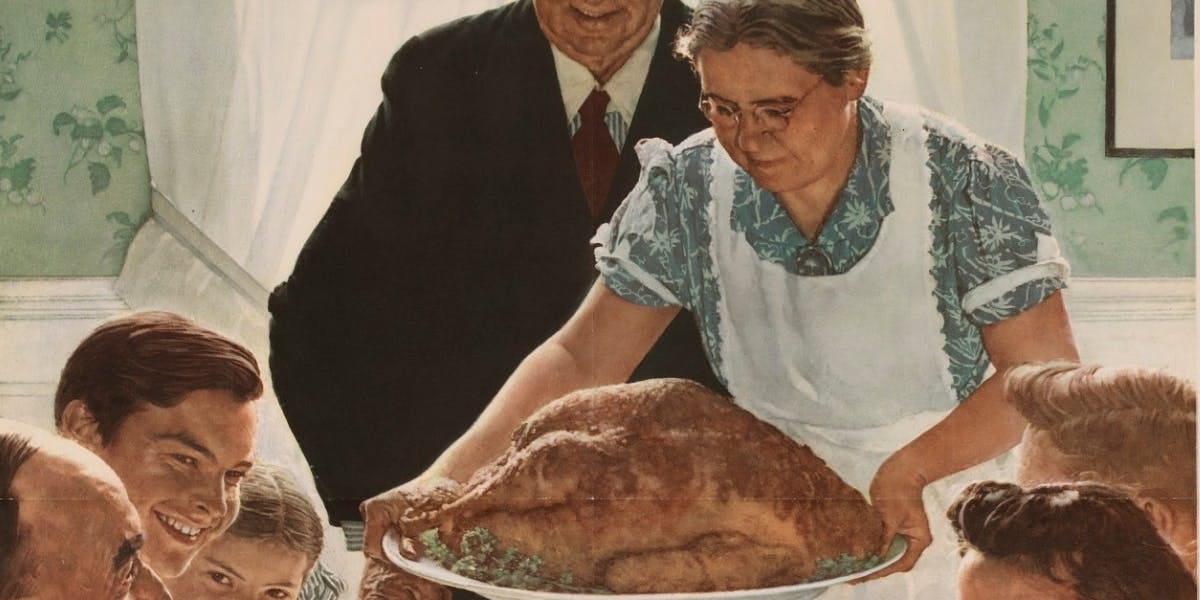
Thanksgiving is coming. Oh my. I’ve written before about how I don’t celebrate Thanksgiving, not because I’m not thankful, because I absolutely am, but because I associate the day with a very particular type of very visceral and visual type of death and suffering. Since the world doesn’t recognize or acknowledge my personal tragedies, my revenge is to avoid holidays where we eat a lot of my favorite things and tell the old stories I love.
It’s not that I’ve given up the celebration entirely. If asked enough, I will participate. It’s just not my preference. You’d be surprised how often the world utterly ignores my preference “for the children” or “For your grandmother” or some similar reason.
The first time I decided to try and take a girlfriend, it ended in her death, what I tend to call a “chosen death” rather than the more common word “suicide” because I think my version is more accurate. My first romantic associate chose to die, although she may not have felt like she had other choices.
Often, when I write about this, I say she had Bipolar II. I probably shouldn’t. This is a theory I’ve developed by studying what I know about the case, not because it’s what her mother, who found the tiny dangling body, ever told me.
Sometimes people are shocked and offended by how frankly and visually I describe these things. I believe we should deal frankly and openly with what terrorized us, and nothing is more terrifying than the death of a brilliant and beautiful child. If she was brave enough to face her own mortality, then I am brave enough to make words of it.
I suspect Bipolar II because it has more of the low-end of the cycle than the high. This makes it more fatal than Bipolar I. I don’t think she had general clinical depression because I have that, and I know what it’s like. I don’t suspect schizophrenia because my brother had that, and I talked to her every day, and never noticed any pattern of irrational thought (more irrational than other thirteen-year-olds), so that leaves bipolar two as the main suspect.
I rested for two years.
“Oh, you poor, poor thing.”
“Please leave me alone. I’d rather not discuss it. Despite what you say, I don’t need to do it.”
I often lied as a child. I thought it made me stronger.
My second romantic associate, much like my first, made the decision for me. She decided we were a predetermined thing. To convince me of this, she deployed a tactic I hadn’t experienced before. Erotic suggestions over the telephone make a tremendous impact on a sixteen-year-old boy. Fifty years later, it still works.
She was celebrating Thanksgiving by having her wisdom teeth removed. On the telephone, we sometimes discussed how her father, like my brother, occasionally had irrational thoughts and heard voices that weren’t there. A chemist by education, he worked for the state crime lab and considered himself a cop. His wife convinced herself that the chemicals he worked with were responsible for what happened next. I never agreed with her theory.
I spent Thanksgiving eating turkey and goose, oyster dressing, roast asparagus with hollandaise sauce, boiled eggs, wild rice and sausage, mock cheese soufflé, sweet potato casserole, boiled custard, pecan pie, and Primo’s Caramel cake.
My girlfriend had chicken bullion and jello.
“Arf youf cominf overf?” She asked over the phone, her mouth still swollen and filled with gauze and cotton. “You bet!” Was my reply.
Since she was sick, we were allowed to meet in her bedroom, on her bed. She was dressed like a bride of Dracula. I’m not sure why a sixteen-year-old had such an elaborate satin gown, but she did. Maybe it was borrowed. Since kissing was out, she guided my hands to the more interesting places lightly covered by satin while we pretended to watch black and white TV.
A figure silently passes by her open bedroom door. “Hey, Daddy.” She says to get no reply.
Going back to our silent pas de deux, I could hear one door close and lock, then another.
At this point, I should mention that, in two years, I had grown quite large. I lifted weights every day and experimented with sports drugs, which were legal but uncommon at the time.
A quiet autumn afternoon. I watch Andy and Barney on the television with my best girl, a shot rang out. I smell burning powder.
“Stay here!” then “NO STAY HERE!” The second one did it.
The first door was locked. I leaned into it, then insisted, bits of door and door frame fly into the master bedroom. The door to the master bath was also locked. One push from two open hands, and its privacy lock was in pieces.
On the floor of the bathroom, a fifty-year-old man lay, his legs kicking violently. I smell gunpowder and blood. Kneeling beside him, I lift his torso to mine. There are two holes in his head, one small with black marks around it, one considerably larger with liquid red shooting out in spurts.
I try to contain the spillage from the large hole with my hand; it spurts, then flows through my fingers, and then stops. A giant circle of crimson grows around me, spreading to the very edges of the world. The legs stop moving.
What happened next was loud and confusing and crowded and emotional, but not for me. I changed my now red shirt with a smelly but dry sweatshirt from the trunk of my Ford, which we called “traveler”.
I find the cigarettes hidden in my glove compartment and swallow one. Her uncle catches me. “We should quit.” He says, while I swallow another.
A police officer, whom I recognize as one of Dad’s childhood playmates, tells me he asked a woman on the police radio to patch him into my dad’s phone. I had to travel quite aways to escape my father’s influence. His friend explains the situation. Through the police radio microphone, I explain that I’m okay, but I may need to stay overnight.
Through the night air, over the police radio, my father’s voice says, “Call if you need anything. We love you, Buddy. “This wasn’t neglect; it was a matter of trust. My father believed that I was man enough to face death, so long as it wasn’t mine.
In the years to come, while searching for reasons why I wasn’t meeting their expectations, my parents would discuss whether I hadn’t seen enough of life, but had seen too much of death. It’d be almost ten years before my father understood what was actually wrong, and then he died.
In the years that followed, my Beloved psychologist, Doug Draper, would ask about my thoughts on the incident, perhaps a thousand times. I found it was easy enough to discuss the details; I never had much opinion on the feelings. I tend to act like I don’t have them.
Not long after, I lost all contact with that family. I felt like I’d given all I owed. There were lots of other girls. I did my best to be nice to them, but I never allowed them inside of me, even when I was inside of them.
People who choose their own death create problems for the people who don’t. More than anything, this is why I never could do it, even though major clinical depression often ends that way.
People who choose to die are often the smartest ones. Make sense of that if you can.
Holidays are a time of memes and rituals where we practice and nourish our human connections. As important as I think that is, it’s not something I do very well. If you want to know if I love you, it’s best to wait for a letter. My words say more truth than the rest of me.
What a sad story.