Irrational Exuberance
The fall of Camelot and new growth

In 1996, Alan Greenspan coined the term “irrational exuberance“ to describe what he considered was the breeding ground for a stock market crash based on baseless optimism that artificially inflated the stock market. The crash did happen, whether that was the reason or not. Greenspan has been the most influential financial leader in my unusually long lifetime. Doesn't mean he's always right.
Last night, I had the intention of having Mississippi farm-raised oysters to celebrate a good day on balance, but one that reminded me to be wary of irrational exuberance, because I have a tendency for it. Always.
At the entrance to Walkers, I ran into Doug Boone, the newish head of the Fondren Renaissance Foundation, and his lovely wife. Both his father and hers were featured players in the apex of Mississippi Camelot. Although I'm sure he's aware, I don't think Red Moffat will admit in public that Camelot is over. Good for him.
For much of my life, Chrissy’s grandmother was one of the few people who knew the Campbell family attended church because she often sang at the morning service in the choir loft, where my questionable clan would assemble, as my father believed in a very private personal life. Mrs. Cable, the singer; Mary Taylor Sigman, the organist; and Clay Lee could see us, but not many others. I suppose that if God were to peer down at Galloway, He'd see the tops of our heads. But at 8:30 on Sunday morning, even Ken Roberts wasn't ready to spend much time in church, so God might have taken a moment to enjoy his coffee instead.
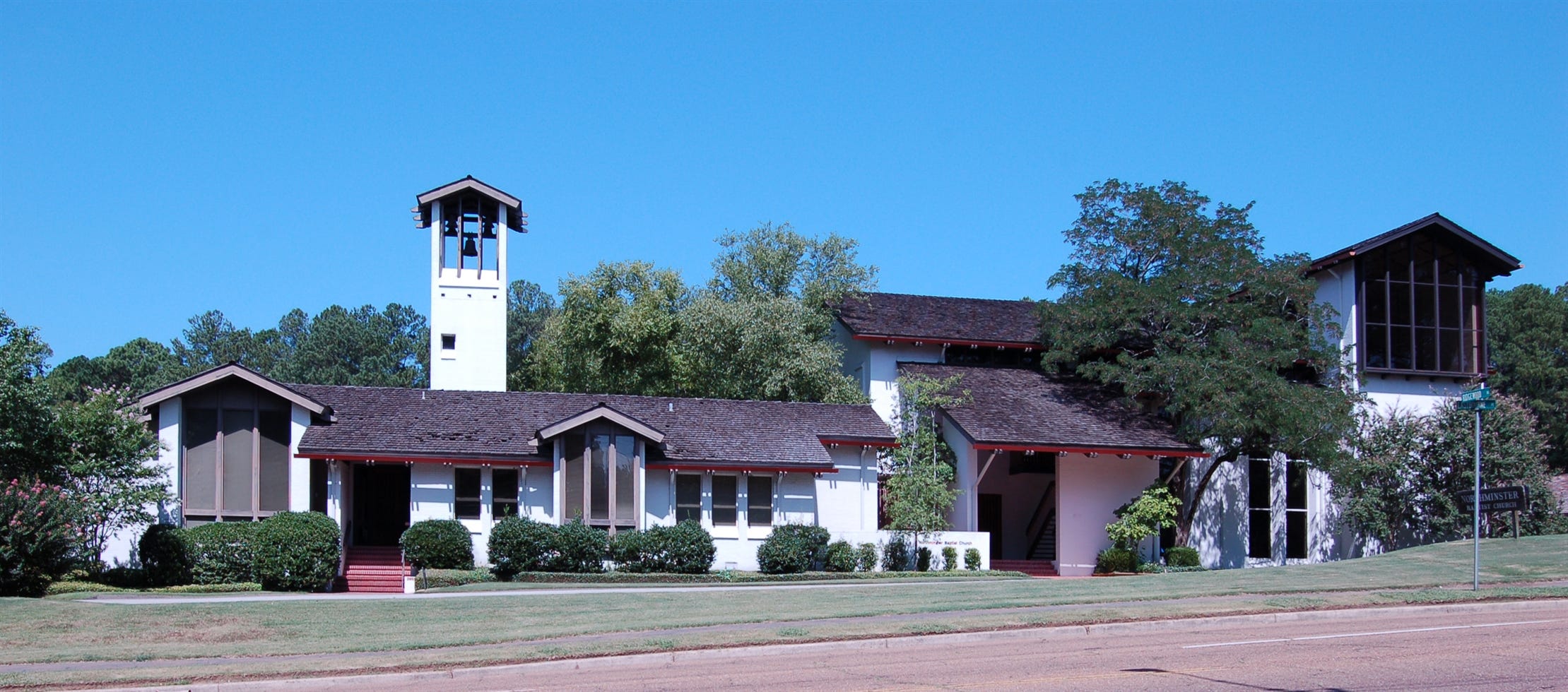
I had actually forgotten Doug stole his wife away to Northminster Baptist Church. One of the guiding lights of the Galloway UMYF of my childhood, she seems to have settled in nicely at this anchor congregation in Mississippi.
Northminster, from its architecture to its founders, played heavily in the Mississippi Camelot years, when some remarkable young men decided that the current Baptist leadership no longer represented their understanding of Jesus. Leaving your church and starting a new one is a remarkably brave and painful move. It was a move taken by some young Mississippi Mavericks. I'll mention two, John Palmer and Leland Speed. That should give you a hint about where the story is headed. I mention them because I know and love their children. They also featured heavily, but in different ways, in my memory of the Great Easter Flood of 1979.
If it keeps on raining, the levee's going to break
If it keeps on raining, the levee's going to break
When the levee breaks, I have no place to stay
Mid-century modern architecture is the calling card for the Mississippi Camelot era. When you see that, start digging.
A few years ago, Northminster had a painful breakup with other Baptist congregations over the issue of who is, and who is not, entitled to the full countenance of God's love. The Nothmister folks said “everyone!” It got them in a spot of conflict. A few years later, the United Methodist Church faced the same question. My church and the conference as a whole moved in one direction, while the larger Mississippi congregations took another path. At times, doing what you believe is right in the face of the Lord comes with a price. The price is worth it, though you may wonder in the moment.
As I probed Doug's mind about the future development plans for the Fondren District, savoring my oysters and especially my Cathead peach whiskey cocktail, we discussed how he and his lovely wife had left Jackson to seek their fortune in Atlanta. When they left, Camelot was going stronger than ever. John Palmer's telephonic company was making everybody in Mississippi rich, and Deposit Guarantee had one of the largest and most profitable asset portfolios in the Southeast. However, when they returned six years later, it was over. Gone with the wind. Camelot had fallen. The victim of irrational exuberance.
Mississippi has its own gravitational field. Many souls try to achieve escape velocity, but it ultimately brings them back. Stronger, smarter, but perhaps a bit melancholy about what was lost.
I came out of my long slumber in the cave because it was that or die. I chose “not death.”
One of the first things I did upon returning to the public eye was to loudly reaffirm my commitment to Mississippi, to Jackson, to Millsaps, and to the United Methodist Church. A lot of people considered if I'd lost my mind. You couldn't even drink the water in Jackson. It was killing Millsaps, and from what I could see, there were more Mississippi Methodists against us than with us.
Still, let this be the hour when we cross swords together! Fell deeds await! Now for wrath! Now for ruin! And the Red Dawn! Irrational exuberance for sure. My sword was old and dull, my body maybe still half broken—it was a mad decision for a mad man!
Still, in the fading sunset, eating sweet oysters and drinking with old friends, surrounded by young people who also share the vision, I made the right choice. The only way to face insurmountable odds is with swords drawn. Fortune favors the brave.
For a while, in high school, Neil Brown decided people should call me “The Celebrity.“When I asked why, he said, “'Cause everybody knows who the fuck you are!” I hated it. When everybody knows who you are, it's not always for the reasons you want to be known. They may hate you.
I was huge. I had an even bigger mouth. I only fought people with more power than me, but I fought all the time. Fighting our new headmaster, who I thought was hurting my friends, landed me without a high school. My point was that the school was the people. His point was that the school was its principals. We fought, and I lost. Irrational exuberance won't always save you. Not in the moment.
At the last dance of the year, I arrived, not invited, but not uninvited, with a pint of decent Canadian whiskey in one inside pocket of my navy blue blazer, and a pack of Dunhill cigarettes and two cigars in the other. I soul-kissed a girl three years younger than me who never told my secret, which is good because her mother, who worked at Millsaps, would have my head. I was a maverick, a troublemaker, and decidedly not daughter-kissing material. She's almost sixty now. The experience seems to have done her no harm.
At the punch bowl, the headmaster who had defeated me held open one side of my jacket, revealing the bottle, then the other side, revealing the cigars. He patted me on the shoulder and smiled.
Considerably smaller than me, he said, “I'm actually going to miss you, Boyd. Don't be a stranger.”
“You know I'm right, don't you?” I said. “About the school, about the people, about Mississippi. You came here expecting to find one thing, but found something else. Admit it.”
“Time will tell.” He said and took one of my imported cigars. Not Cuban, that was illegal at the time, and beyond my price range. Friends should share cigars. Were we friends? As they prepared for the big St. Andrew's Seventy-Fifth celebration, someone contacted David. He asked about me, remembering me fondly, or so he said. Are we friends? I don't mind being friends with a former adversary. We did share cigars.
What did time tell? Does irrational exuberance pay off in the end?
I dunno, baby. I’m just here for the oysters and the tunes, man.