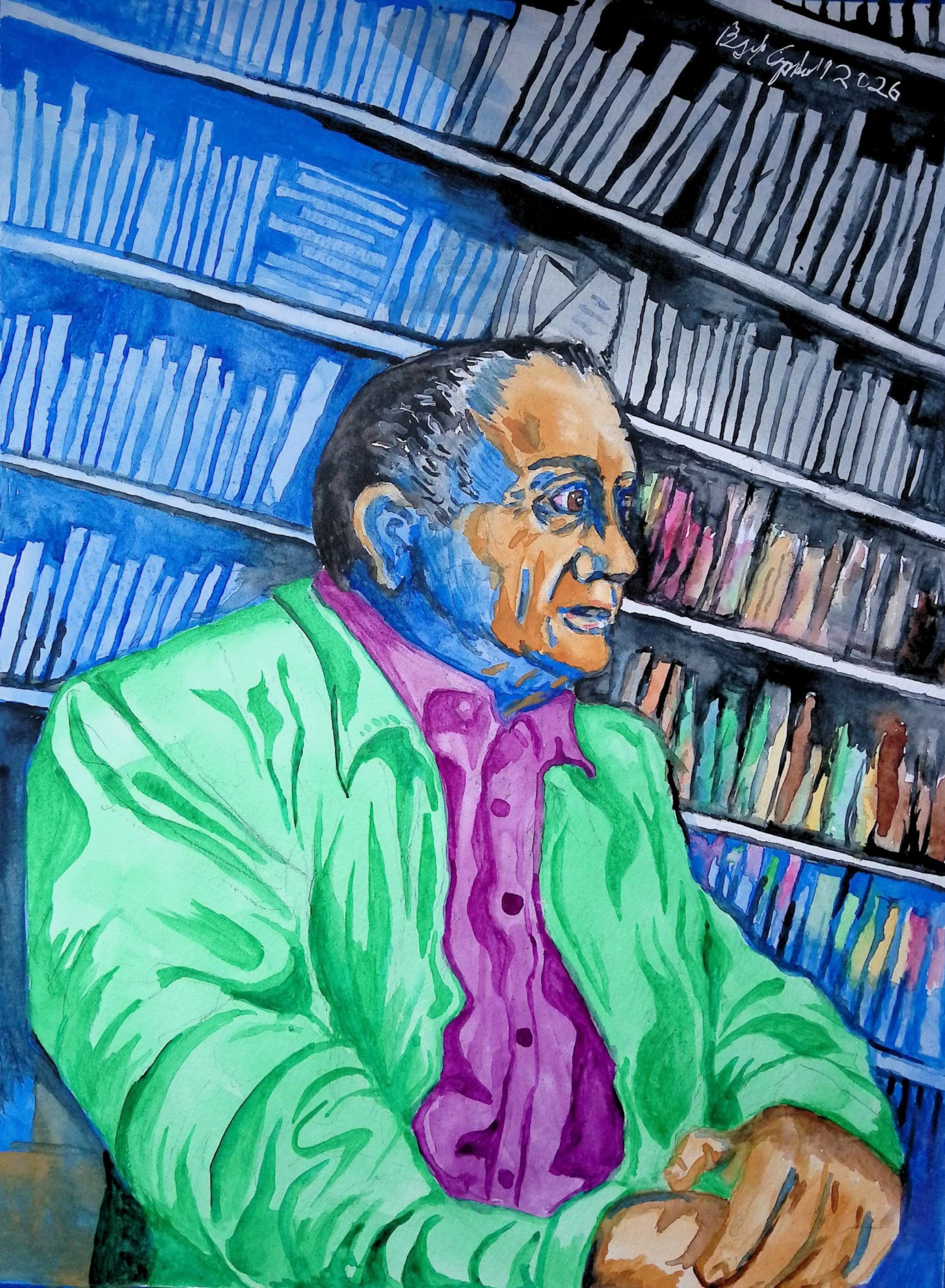
Lance Goss
Water color 11 x 15

What can I tell you about Lance?
Master, Major, Mentor, Teacher, Trainer, Director, Instructor, Friend, Companion, Collaborator, Contributor, Fellow Traveler, Brother.
Lance was in my church and my fraternity when my father was a boy. He was at both Galloway and Millsaps through our worst and our best years. Lance could have pursued his dream of professional theater. He was deeply involved with the original production of “You’re A Good Man Charlie Brown” With Gary Burghoff in the title role.
As an actor, Lance had no parallel, but as he aged, after Frank died, he began to lose confidence in his ability to remember lines.
When my father died, I lost the will to escape to Hollywood as we had planned. Instead, I ran to Lance for comfort and recovery. As he neared the age where the school would require him to retire, he decided to have a heart attack instead. I shadowed him for his last two shows, “The Day After The Fair” and “Dangerous Corners.” Lance had done both shows before. Anna, in Day After the Fair, is now a history professor and member of the Administration at Millsaps. His last play, Dangerous Corners, featured all his favorite members of the company, including Gabby and Nicole, but also Matt Henry, who died shortly after Lance.
Lance kept my secrets, and I kept his. He borrowed my cigarettes, and I borrowed his lighter. At Galloway Memorial United Methodist Church, Eudora Welty sat in front of my grandparents, and Lance sat in front of her. Lance lived on campus forever. Rather than renovate the faculty lodges, the school decided to tear them down. I always wondered if having to move wasn’t part of Lance’s heart attack.
For Lance’s last play, I could feel him slipping away with each rehearsal. Lance, always a professional, believed that if he wasn’t early, he was late. At one rehearsal, Lance didn’t show up. I found him on a pew in the hall near the History department.
“I can’t do it anymore.”
“What? What can’t you do, Bud?”
“Any of it. I can’t do any of it anymore.”
“I’ll be beside you. We’ll do it together.”
We both cried.
Thinking of that night, I didn’t have the strength of heart to help Lance move into a nursing home. I didn’t have the strength of heart to bury him. Ward did, though. I owe him.
What can I tell you of Lance? My master? My friend? My director?
What can I tell you?
I miss him. I miss him more than you can imagine.
My style has become very expressionistic. It seems to be developing. These aren’t real-life colors. The colors of Alpha Psi Omega are Moonlight Blue and Bastard Amber. Lance’s face has Bastard Amber highlights, and his shadows are Moonlight Blue. Both are Rosco Gel colors. Lance would never wear a bright purple shirt and a bright green windbreaker. I chose these colors to counter the blue of the books and to suggest that memory and dreams are more vibrant and colorful than real life.
My first thought was to paint him in his rocking chair because that’s how he directed, but for most of us, we couldn’t see him in his chair. He was a voice in the dark saying, “No, no, no, Bud. Do it agian.” His office was how you knew Lance. His office was the gathering place for not only theater kids, but all the arty kids. Some of his books use somewhat natural colors; the rest are shades of blue and grey, the colors of fading memory.
I worried myself sick with this painting. I’m not displeased with how it turned out. I’m donating it to the Millsaps Players, as is befitting.
Lance used to tell us to project our voices loud enough that our grandparents in the back could hear us. I wonder if I can project enough that he’ll hear me now.