Life After Death
a story about Uncle Forry

Summer, 1982. The Little Bird is just an egg sleeping in her mother’s tummy. An egg I would have easily given my life to protect. Her mother, being a very practical sort, never put me in that position. I can’t tell you the times she made sure my life was protected, though.
Working for my father, I saved my money so I could take a trip after my birthday. I wanted to go to California. I wanted to meet somebody. I knew that every Saturday, he invited boys like me to his house on Glendower. He was no kin to me, yet I called him uncle. Having never met him, only my father made a bigger impression on me and my life in that year before I started College.
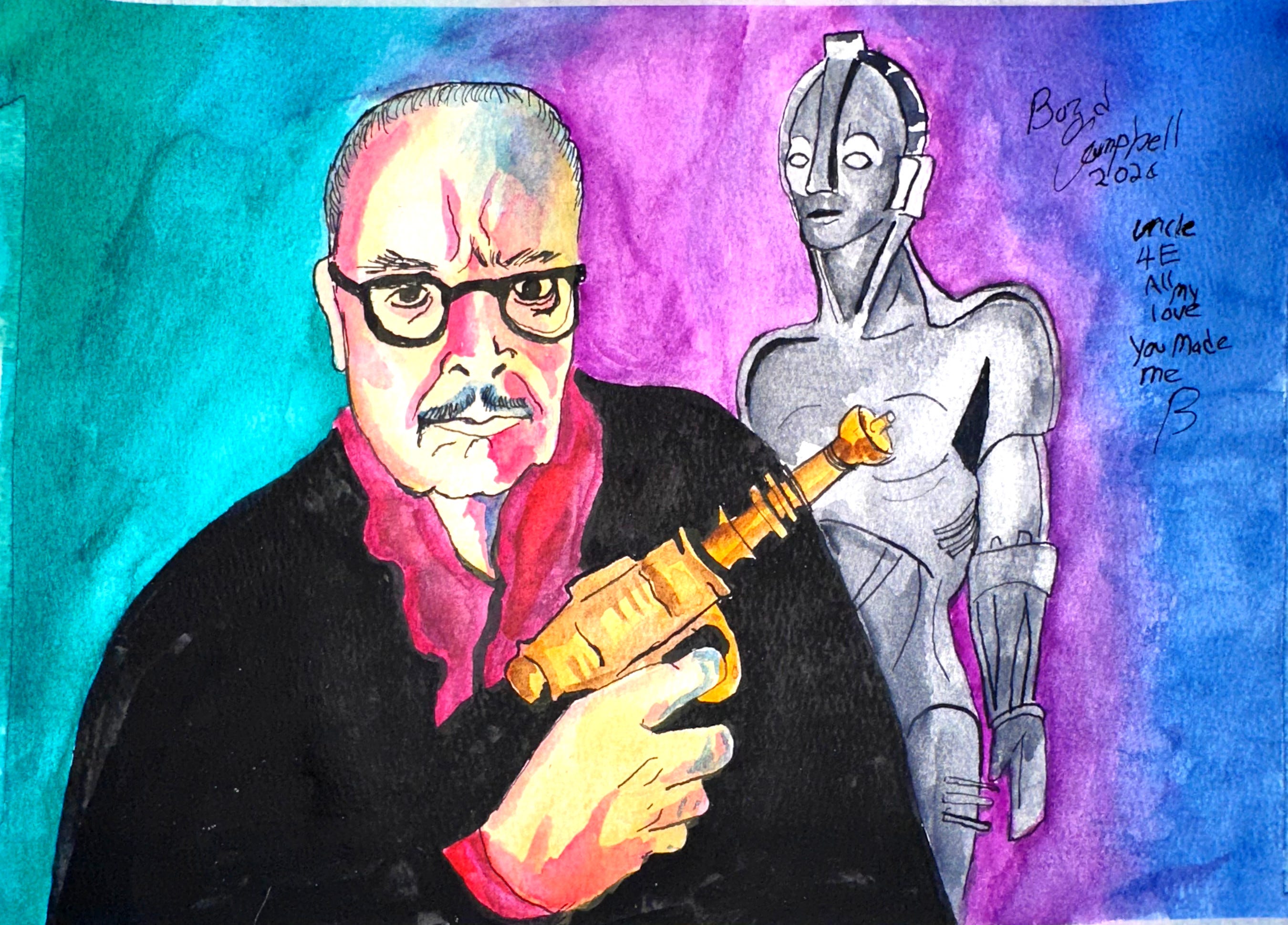
You’d be surprised how many science fiction-obsessed people are skeptics. Forrest J Ackerman, one of the world’s most famous Science Fiction Fans, was a profound skeptic. He was an atheist and an anti-spiritualist. He didn’t believe in religion, the occult, or life after death, but he knew everything there was to know about vampires, including owning Bella Lugosi’s last Dracula cape and Dracula ring. He was Uncle Forry. He welcomed me into his home.
“Mississippi, huh. Mississippi. I’ve been to Mississippi; it was during the war.” Forry served in the Army at Fort MacArthur, California, where he edited the base newsletter. He’d been publishing his own science-fiction newsletter since high school. In one issue to his science fiction club, he wrote about “Ackky In Khakki.” Forry loved terrible puns and wordplay, but he didn’t believe in ghosts.
Last night, my friend Angel Bolton sent me a video that made me cry all the way through.
”Hey, you know who Forrest Ackerman is, don’t you?” She said.
“Why, yes. Yes, I knew him quite well…”
My Mississippi father had reservations about my California Uncle. He thought he was something of a nut. He wasn’t entirely wrong. Forry was unique among the uniques. Fifteen years older than Daddy, they had several things in common. Forry was in the “Greatest” generation. Daddy was in the “Silent” generation, although he was anything but silent.
Daddy and Forry were both strongly against the death penalty. They were both deeply devoted to the development of young people. Both opposed the action in Vietnam. Both took a position on the Civil Rights issue, but later wished they’d taken a stronger position. Both were very devoted to higher education, although Forry never graduated from UC Berkley. He left during his Sophomore year to take a job as a movie projectionist, so he could see movies for free.
Daddy had deep reservations about writers and California and science fiction, but, in the end, he was the one to notice that I couldn’t live in Mississippi.
“You’re dying, aren’t you, Buddy?”
In the end, he was the one to make a plan to send me out of Mississippi to my California uncle, but he died before we could launch the rocket. I ended up living a few years longer than my father. I would have bet money against that. Don’t lie, you would have bet against me, too.
Though not as large as I, Daddy was a large man. Like Forry, he loved anything with the word “modern” attached to it. He had a gigantic Herman Miller “Modern Apex” desk that’s been out of production for years. It was big enough to bury both of us in.
About four o’clock every day, he would begin the process of “scrubbing” his desk. Every scrap of paper, every bill, every letter, every magazine article, every report, every print-out, all of it would be looked at, dealt with, and cleared off his desk. His desk was big enough to play pool on, and by the time I came to have an “end of day” drink with him, it was absolutely clear. Burl Veneer from me to the other side of the room, but all his work was dealt with.
Forry, Ray Bradbury, and I have different ideas from my father about desks and how uncluttered they should be. I have three desks. One has my computer(s) and my correspondence. One has my 3-D art, which is currently my staging platform for the most amazing thing from StannArts. Have you ever heard of Kong?
One desk is for my 2-D arts. Both have their own art cart filled with tools. My very first friend, who wasn’t Momma’s age, said I should paint more.
“How much?”
“Every day.”
She thought I wouldn’t. Teach her to think, this will.
Up to my elbows in paint, both hands covered in blacks and rusts, my Facebook messenger dings. “You have Amazon Prime, don’t you?” Angel asks.
Another of my childhood friends is a blonde. I don’t normally study blondes. I know what happened to my friend from Skull Island. She has a remarkable presence of mind, though, as all my girls do, and she had a remarkable life, beginning with when she died. These days, Nicole Angelique Kerr is probably best known for her book “You Are Deathless” about her experience dying, coming back, what happened in between, and what it meant for her life, and for yours.
Forry didn’t believe in the eternal soul. My father did, Nicole does, and I do.
Realizing, if I was going to be an authentic Christian, I’d have to answer the intellectual criticism of atheists with something more than “this is just what I believe.” Christopher Hitchens was an amazing mind. He attacked Christianity with its own words, “‘Think not on the morrow.’ Can you imagine any more horrid advice? Think not on the morrow means do not plan for your life, do not work for your life, do not prepare for your life, because your imaginary father in the sky will care for you. Following the words of your Jesus will just get you killed.”
Hitchens was right. “Think not on the morrow” means certian death, and yet Jesus said it. A lot of people think it was a metaphor, and excuse it that way. Some monks take the advice literally, but they can only survive because the rest of the world does not, and provides them with bread and clothes. I’m not sure that’s what Jesus meant.
To answer this, I took up the question of an “eternal soul.” Eternal is a concept we struggle to hold in our minds. We struggle because our minds are finite, and eternal is not. It means no beginning and no end. We tend to draw time as a straight line. Imagine time as a loop, or even a sphere. That is eternal. Taken literally, we have existed for an eternity before our time on earth, and we will exist for an eternity after our time on this earth.
The answer to the challenge presented by Hitchens lies in Newton. Matter and energy are eternal. They’re never created, nor destroyed. They can only change form. Conceiving the soul as one of Newton’s eternals, we begin to see a path where life after death is possible.
Taking that into mind, whatever horrible experience we have here on earth begins to lose its sting. Our time here is an infinitely tiny speck on the surface of the eternal sphere of our existence. Sophocles said, “To know nothing is the happiest life.” Interpreting his play Oedipus at Colonus into a musical in English produced one of my favorite hymns:
Live where you can
Be Happy As You Can
Happier than God has made your father
Live where you can
Be Happy as you can
For you may not be here tomorrow.
Angel sent me a link to a film, “The Life After Death Project, Part 1,” available on Amazon Prime.
Watching it, almost immediately, I started saying, “I know him. I know him. I know him too. Oh my, he looks so young. Oh my, he looks so old.” Still covered in paint from making King Kong, I wept at the memory of my Uncle Forry.
As publisher of Famous Monsters of Filmland Magazine, Forry became the uncle to thousands and thousands of Boomer and Generation Jones boys. I always considered it an all-boys club. Recently, I learned that Little Bird’s mom knows more about Sci-Fi than I do. Filed under: “Data I could have really used when I was sixteen.”
Stephen King was a Monster Kid, so was John Landis, Rick Baker, the Monster Maker, Steven Spielberg, Peter Jackson, and, well, me. I’m not famous, though. Not yet.
Though Forry loved fantasy films and stories, like me, he was acutely aware of hard science. Like me, he strongly preferred strong-science Sci-Fi to space-opera Sci-Fi. He would have said that the designs and the themes of Star Wars were very good, but that the science in Star Trek was better. I agree, although transporter systems create a problem.
If you destroy a person’s atoms, then transmit them with a quantum beam to be reassembled in another spot, what does that do to their individuality? Is it the same person before teleportation as after? Considering that not only the body, but the mind teleports as well, you’re talking about levels of complexity to rival the whole universe. I dunno, maybe I’m missing something.
I mostly knew Forry after Famous Monsters fell apart, and the death of his beautiful wife, Wendy. I was acutely aware that he was a diminished man. Losing both his life’s work and his life’s love, letting boys from all over the world into his Glendower mansion every Saturday buoyed his existence.
I could probably go through my journals and count how many times I visited Forry on Saturdays, but it’d be pointless. Let’s just say hundreds. Every summer for twenty years. Forry, for a moment, thought Famous Monsters was revived, but it turned out to be a scam. The scammer used a legal trick to steal his life’s work.
The lawsuit, known among Monster Kids as Forry vs Ferry, cost a fortune, but Forry won. He won, but what did it cost him? With his health and his finances failing, a gigantic Pacific Islander named Joe Moe became Forry’s caretaker. When I saw him in the video Angel told me about, I knew there was something to it. Joe Moe held anything to do with Forry as near sacred. If the guys making this movie weren’t pretty legit, he’d never be in it.
I got to see parts of the Ackermansion that most fans never did. I got to see his bedroom and his bathroom. He rescued a baby squirrel and kept it in a cage in his bedroom. He turned down Wendy’s side of the bed every night, but you could tell his side was slept on, while hers was pristine. If Wendy’s spirit somehow survived her death, it didn’t leave an impression on the bedclothes.
Then they started to die. First, Fay Wray. Sensing the end was near, the management of the Empire State Building invited her to take a trip to the top. Nobody ever uttered the words “one last trip.” They contacted her daughter and Ray Harryhausen to encourage her. Dianna Harryhausen contacted me. I didn’t get to go up with them. I stayed on the first floor, crying, while Ray, his wife Dianna, and the Bravest Girl I Have Ever Known stood behind the beautiful Art Deco elevator doors as they closed.
If Fay’s Soul is eternal, I’d love to think she haunts the Empire State Building. If her soul is eternal, I’m pretty sure she visits mostly Canada, where she left her mother. Fay liked to write. The last thing she wrote was a play called “The Meadowlark” about her mother. When James Cameron offered her the role of “Old Rose” in Titanic, Fay turned it down. She planned to spend the summer with her daughter, producing her play in upstate New York, where Vickey Riskin taught. Fay had three children by Riskin. All remarkable. All beautiful. He died far too young. In her forties, she returned to acting so she could support her young family. In so many ways, Fay really was “The bravest girl I have ever known.”
After Fay died, it was like somebody took the trusses off the bridge. Soon, Forry, Bradbury, and Harryhausen were all gone too. Forry’s massive Science Fiction Collection was stored in a warehouse to be auctioned off piece by piece. They show the warehouse in the film Angel sent me. It made me cry. I knew where all the art was hung in the Ackermansion.
I’d like to believe in life after death. I’d like to believe it’s not wishful thinking. I’ve had experiences, but they don’t prove anything. They just make me lonely.
“You’re dying, aren’t you, Buddy?”
When I was little, I began waking up at five AM so I could spend an hour with Daddy before work. We didn’t talk because Momma was sleeping, but this is how I know my father. This morning, I made the coffee and did bathroom things at five am, like my father. At six, I texted Little Bird and her mom, and Collins and her mom. “Good morning, ladies. I love you.”
Feeling my life grinding to a halt, I’d wake up at five in my home on the poorly named reservoir, and sit on the side of the bed, and smoke, waiting for death to settle on my shoulders like a bitter cold rain.
From his car (cell phones used to be attached to cars), Daddy would call me at six. “Hey, Buddy. You moving?”
Some days, I would stare at the answering machine as it took Daddy’s call. There was a phone in my car too. I’m pretty sure he called both. If I were up and driving to work, I’d answer the car phone. If not, he’d call the bedroom phone. Answer or not, he’d say the same thing, “Hey Buddy. You moving?”
The plan to get Boyd to California was kept a secret, even from Momma, because the Monkey was getting married and I was adamant that I wanted nothing of me to steal her spotlight. I wrote yesterday about how much I worshiped my little sister, despite her being born with a tail.
I took a long lunch, which included a drinkiepoo or two. The girl in Memphis said I should marry her, then called while she was fucking another dude to say it was off. The one before her said she loved having dinner with me, but what she really wanted was a job, health insurance, and one goddamn unpaid loan after another. Shirley Olson told me she was brilliant. She didn’t tell me she was evil.
Coming back to the office after a long lunch, there was a note on my desk. “Go see your daddy.”
Walking down the long hall from my office to his, a frantic voice comes over the intercom, “IF ANYONE KNOWS CPR, COME TO MR JIM’S OFFICE—NOW PLEASE NOW!”
It’s a bit intimidating when I break into a full run. That’s a lot of mass moving in one direction. By the time I get to Daddy’s office, he’s on the floor beside his gigantic table. Phyllis is weeping in the corner. Pat Ross was giving Daddy Chest compressions.
When you die, your body relaxes, including your bladder. Phyllis covered the wet spot on Daddy’s pants while Pat Ross continued chest compressions, and my brother Joe breathed for my father.
He was dead.
My oldest brother, named for my father, was diagnosed with Schizophrenia, then bipolar, then Schizophrenia again. From what I can see, these things, including my depression, represent a spectrum of the same illness. The entire world was worried about how Jimmy would take Daddy’s death. Nobody paid attention to Boyd. I made sure of it.
My friend Melanie married my Friend Alan, a fellow traveler. No, really, we were called “The Travelers.” She called and said she was coming over. She had a pillow and a blanket with her. “I’m gonna sleep on the couch.” She said.
Unable to sleep, in the dark, I got up from my bed and lay on the floor beside the sofa where she slept. She let her blanket spill over and cover me. I’ve never mentioned this before, not even to her. Sometimes she reads my stories. Hi. Thanks. I love you. I love you both.
Getting ready for daddy’s funeral, I lay out my black suit the night before, black shoes, white cotton boxer underpants, white cotton “wife beater” undershirt, white cotton beefy Oxford cloth Oxford shirt. Three ties, including a Nicole Miller that my dad liked. I chose the Millsaps Purple one.
I talk about how many people went to my sister’s Wedding. Cecil B DeMille called and said he wanted his extras back. So many people drove to Jackson for Martha’s wedding, then drove back to Jackson for Daddy’s funeral. I think there were more people at the reception at Wright and Ferguson funeral home than at the biggest wedding Central Mississippi had ever seen.
So many of the women in my life stood in line to say goodbye to Daddy. Katie’s mom and dad were there. They were friends with Daddy through YPO. The girl who ruined my trip to see Phantom of the Opera came. I cried when she hugged me. Somehow, I felt like I was the one who should apologize. That’s kind of my way. It’s a pretty stupid way.
The morning of the funeral, I sat on the side of the bed, smoking, looking at my clothes on the chair. For an hour, the sunlight began creeping through the blinds. You can hear so many birds and other things on the water at the reservoir. I didn’t move, except for the cigarette arm.
At six o’clock, the phone rings. I look at it. The ringing stops.
It rings again. I look at it. The ringing stops.
The third time it rings, I pick up the phone, and there’s nothing. Not a dial tone as there would be if I imagined the ringing, just silence, blank, purple, dead, silence.
Before he died, Daddy had been on the board of directors for BellSouth (another board to sit on) for seven years. My phone service was through BellSouth. Before he died, He’d been calling me every morning at six am. “You moving, Buddy?”
I’m not gonna say it was Daddy’s spirit calling me. I suspected my mother and Pat Jeffreys, but they both denied it. I never asked Melanie, but I dunno if she’s the “get up at five am” type. Most folks aren’t.
What I experienced was about as conclusive as the “evidence” presented in the film about Forry. Forry was pretty adamant that he didn’t believe in the hereafter, and here were the guys who knew him, guys who I know myself, including Joe Moe, his caretaker, who Forry called “a son among nephews,” saying, “Maybe.”
Maybe
You moving yet, Buddy?
Nicole Kerr’s Book, “You Are Deathless,” is available on Amazon.
https://a.co/d/0b65YXl3
The Life After Death Project, Part 1 is available on Amazon
https://www.amazon.com/gp/video/detail/B0DJXLHBZ2/ref=atv_dp_share_cu_r