The Birthday Dinner
science fiction sunday

It’s Mary O’Ferrall’s birthday. The kids where she works as a teaching assistant sang to her. Her real name is Myra, but everyone calls her “Mary,” including her mother, who picked the name.
Her boyfriend arranged a romantic dinner. Mary suspects this might be the moment when he goes from “boyfriend” to “fiancé” as he cleverly, but obviously, measured her fingers for size. He’s brilliant at physics, but not so great at understanding women’s wiles. Her friends dropped hints that he consulted with them as to the styles she liked.
Mary met Thomas in the fourth grade. He pulled her hair, and she bloodied his nose. It was fate after that. He preferred books and calculations to human beings. She became his guide and protector. While there have been side quests, neither has ever really bonded with anyone else.
At the appointed hour, the doorbell to her duplex apartment rang. Expecting Thomas, she found a beautiful nineteen-year-old boy, dressed in black pants, a tuxedo shirt, and a black bow tie. He smells of the cologne she gave Thomas for Christmas.
“Dr. Thomas McLendon requests your presence at dinner.” The boy said.
“He’s not a doctor yet. Working on it, though.” Mary said.
The boy presented a gentleman’s calling card. “Dr. Thomas McLendon, Prof.” then under that, “Chairman, Physics Dept. University of California, Berkley.”
“These are so cute!” Mary said. When did he have these printed?
“2004, I believe.” The Boy said.
“That’s funny, it’s 1987,” Mary said.
“Yes, ma’am.” The boy said, ushering her toward Thomas’s car, freshly waxed and vacuumed. In the passenger seat is a single yellow rose. She prefers yellow roses to red.
“What’s your name?” Mary asks her mysterious driver.
“Thomas, ma’am.” He says.
“We’re playing games now, are we?”
“No, ma’am. Not at the moment.” The boy said. “We’re to meet Mr. McLendon at the farm.”
Thomas’s grandfather had a small forty-acre farm with a large pond. Mary loved it there. Thomas’s grandfather taught her to ride a horse there before he died.
Riding quietly as the car moved from the city, to the suburbs, to the country, Mary smelled her rose. It took her three days to decide what to wear. A diaphanous black dress with little white flowers won the election. With her dirty blonde hair piled on the top of her head, she decided that brasiers are polite, but not necessary.
“So, boy whose name isn’t really Thomas, have we met before?” Mary asked her driver.
“Not yet, Ma’am.” He answered.
At his destination, Not Thomas stops to open the gate, then drives through into the farm. Closing the gate, he gets back in the driver’s seat. Bamboo tiki torches light the path from the gate. It winds past the cabin, through the woods, to the pond.
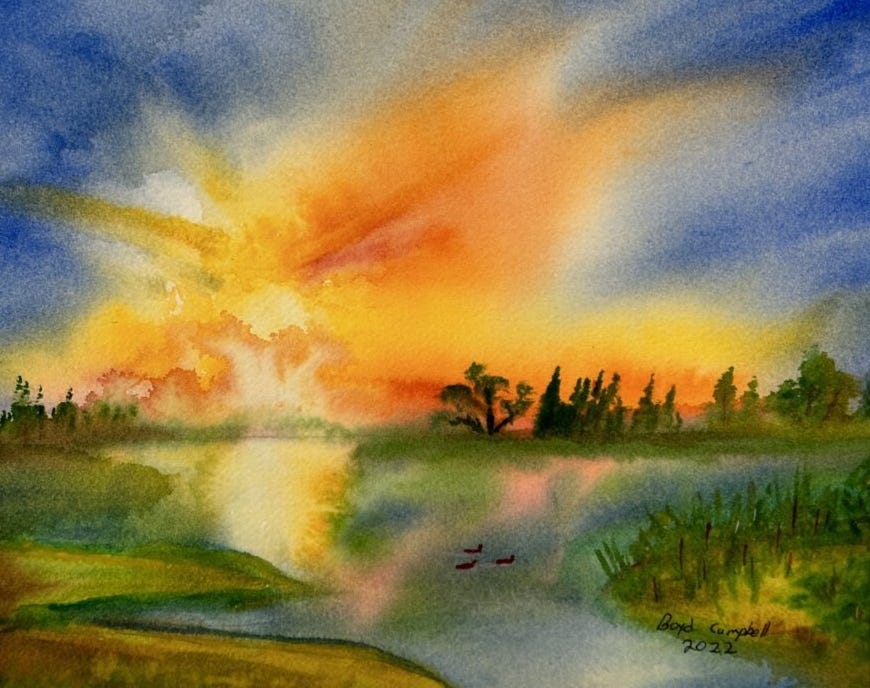
A raised boardwalk leads from the shore of the small lake to its middle, where Thomas’s grandfather built a small deck. Mary once said it was her favorite spot, so Thomas keeps it in meticulous care, replacing boards as they get warped, and applying fresh stain once a year.
Along the handrails to the boardwalk, hundreds of white candles light the way. As twilight moves in, Mary sees a table with a white cloth, candles, and roses. Thomas stands dressed in black slacks and the cotton sweater Mary gave him for Christmas. Next to him is a sixteen-year-old girl, dressed like Not Thomas in black slacks and a white tux shirt. Besides her are three large plastic ice chests.
Thomas pulls out Mary’s chair so that she can sit. Mary asks his assistant for her name.
“Myra.” She says.
“Oh, I guess we’re still playing this game,” Mary says.
On the shore, Not Thomas presses “play” on a black boombox. Mary hears Musetta’s Waltz from La Bohème.
“Dinner is served.” Says Not Myra.
In the corner of the deck, a small metal sphere stands atop a black tube leading to a black box. The sphere emits a pale, blue glow. It hums quietly.
“What’s that?” Mary asks.
“One of my inventions,” Thomas says.
“What does it do?”
“It cleans time,” Thomas said. “Hopefully, it will also keep away mosquitoes, but not fireflies. It seems to be working.”
“I see,” Mary said. “Who built it?”
“He did,” Thomas said, gesturing to his valet at the end of the pier.
“Your games are strange,” Mary said.
“You used to love them,” Thomas said.
“I still do.” Mary takes his hand. “I suppose you cooked?”
“All day.” Thomas kissed her tiny knuckles and brushed his finger over her freshly painted and keenly polished French Manicure. While Thomas spent most of the day preparing dinner, Mary’s friends spent most of the day preparing Mary.
Not Myra and Not Thomas take dishes from the ice chests. Not Thomas serves Mary, Not Myra serves Thomas.
The first course is a chilled tomato gazpacho. Clair de Lune by Debussy plays over the boom box.
“Who’s that playing?” Mary asks.
“She is,” Thomas says, gesturing toward Not Myra.
“She’s amazing,” Mary says.
“She gets it from her mother,” Thomas says.
The sky around them grows purple and dark. Fireflies appear at the edges of the lake. Thomas’s mysterious globe intensifies its glow. A mist begins to cover the lake.
The second course comes from the ice chest for hot things. Three fresh oysters for each of them on a bed of rock salt. Broiled to perfection with garlic, butter, and parmesan cheese.
Imagining a night of passion, Mary says, “It’s good we’re both eating garlic.” She quietly spies his pockets for lumps.
“It’s hidden under the table,” Thomas says.
Champaigne replaces Brandy, expertly served by Not Thomas. The salad course features fresh baby greens and sprouts, accompanied by roasted pine nuts and a light comeback dressing, thinned with Prosecco.
Dinner serves as Caruso sings Che gelida manina from the boombox.
Petite filets, warm, but very rare, rest on a bed of hollandaise. Lump crabmeat and truffle shavings rest on top. Each plate serves with five perfectly poached asparagus spears.
Cutting into her steak, Mary notices its unusual texture. “What is this?” She says. “I love it!”
“It’s called Wagyu,” Thomas explains. “It will be big in the future.”
“In the future, huh?” Mary says. “You and your games.”
Dessert is fresh ripe strawberries, dipped in dark and white chocolate. Once served, Not Myra and Not Thomas excuse themselves and walk to the shore. Mary knows what’s coming. Duo des fleurs by Delibes plays on the boom box.
Hands folded in her lap, Mary’s heart quickens. Thomas reaches under the table and pulls out a small black box.
After a pause, Mary imagines Thomas gathering his courage. “Do you remember when we were children, you told me about how your father died when you were nine. You said, more than anything, you were afraid of ever being alone. I held your hand and promised I’d never leave you alone. Do you remember that?”
“Of course I do. You’ve been very faithful.” A single white tear rolls down Mary’s cheek.
“I am a man of honor. If I promise you something, I will do it, no matter what. I need to show you something.”
The metal sphere glows brightly now. The hum intensifies. Mary can’t see the shore or their attendants because of the fog, just candles forming a path into the darkness. The sphere begins to hum.
Pushing the small box in front of Mary, Thomas lifts the hinged cover—revealing nothing inside.
The universe rushes through Mary’s mind. For a moment, she’s terrified, but she feels Thomas’s hand on her cheek.
Two nurses stand beside the glass window of an ICU bed. Inside, a man rests with an IV, a heart monitoring unit, and a drip. A clear nasal oxygen cannula is connected to a monitor on the wall, which reads “3.5 litres.”
“How is he today?” The head nurse asked.
“He’s resting. They started morphine this morning. His wife and children were here for it. They’re so little. Imagine losing your dad when you’re just nine and twelve.”
“He’s just forty-two,” The head nurse said. “They say he has one of the brightest minds of the century.” The nurse says. “Had—one of the brightest minds.” She corrects herself.
Driving home, Mary realizes she blacked out. She asks Not Thomas what happened. Not Myra sits in the back seat.
“Dinner is over, Ma’am.” Not Thomas says. “Happy birthday.” Not Myra says.
“That thing—that thing on the lake, did Thomas build that?” Mary asks.
“No, Ma’am. I did.” Not Thomas says.
“It cleans time?” Mary asks.
“Yes, Ma’am.” Not Thomas says.
“Cleaning time of what?” Mary asks.
“Of him. Mainly, of him.” Not Thomas says. Not Myra begins to cry.
“We agreed. You did too. This would be best.” Not Thomas says. “He said to remind you how much he loves you, while you still remember him.” Not Myra struggles to be strong, but buries her face in her hands.
At the door to her duplex apartment, Mary asks Not Thomas, “Will we meet again?”
“Not for a long time,” Thomas says.
“How is this possible?” Mary asks.
“It’s his theories, but my work,” Thomas says. “The next time we meet, you won’t recognize me. I’ll have a different face because I’ll have a different father.”
“There’s one more thing,” Thomas says. “He says we agreed, and that’s true. We voted. I voted ‘no,’ but I was outvoted. He promised never to leave you alone. This was the only way.”
“Will I remember him at all?” Mary asked.
“I do sometimes. In my dreams. Maybe you will too.”
“I love you, Thomas.”
“I love you, Mother.”