

The Problem With Asia

When my Uncle Boyd had just been elected president of the US Chamber of Commerce, he got a letter from a Japanese girl about how her father, on a trip to the United States, had proudly bought her a pair of American-made shoes, only when he got home, the box contained two left shoes.
Something of a self-promoter, Boyd approached the US State Department to play this up as a “pro-American” story, and his secretary began pitching this as a human interest news story.
After the war, in the United States, Japan was considered weak and dependent on our largess to survive. Most of that was due to the fact that we had nearly bombed them out of existence, just a few years before, including the largest, most destructive bomb ever—the one that made Godzilla.
It was worse with China. Because of their betrayal and adoption of communism, everybody in America assumed their collapse was imminent, and a period of unmatched starvation would sweep across Asia.
School children were told to “eat your greens, there are starving children in China.” Only there weren’t, but communism was a disaster, and there surely would be soon. Only, it never happened.
By the seventies, Asia was destroying us in the industrial marketplace. Japanese steel and automobiles were leaving us in the dust and embarrassing us. China’s agricultural output soon surpassed, and almost doubled, that of the United States.
Tensions between China and the United States were high. We took the opposite side when the Chinese tried to spread communism in Korea and Vietnam. Everybody in America talked about “the domino theory,” where one asian country after another could fall to communism, until it finally reached India and the Middle East. This, more than anything, was our justification for the Vietnam conflict.
Nixon promised to withdraw the United States from Vietnam and normalize relations with China. “Only Nixon can go to China,” Republicans said. Out of the deal, we got two giant pandas for the National Zoo and a nearly impeached president. When I wrote about our eighth-grade trip to Washington yesterday, we got to see those pandas.
I used to imagine I could write a lyric play called “The Tragedy of Richard Nixon.” My rhyming skills are not up to the task. Sorry. I'm still fascinated by Nixon, and may yet one day write a play based on the night he asked Kissinger to pray with him.
It was assumed that Nixon’s trip was a failure, and so it seemed. He left behind a young George Herbert Walker Bush, who, until he became Vice President, (and a considerable bit afterwards) worked to normalize relations with China. Thanks to the work of Bush, we now have a pretty workable relationship with the People’s Republic of China, even though they’re kicking our ass industrially.
The American Industrial Machine never got the chance to ride into town like John Wayne and save Asia from itself. It’s pretty hard to find a factory that makes shoes in America anymore, but there sure are a lot in Asia. The shoes I’m wearing now say “made in China.” They also need a shine.
I can’t defend Chinese Communism on a human level. To accomplish what they have required unprecedented amounts of cultural oppression and authoritarianism. From a purely economic standpoint, though, their brand of modified communism pretty much rules the world.
We’d like to think that cultural liberty and economic dominance complemented each other. The American dream was built on it—we thought. That doesn’t seem to be the case. It’s said that Chinese Communism is close to slavery. For some people, it is.
When I was in the school supply business, and later when I was in the collectible toy business, I was keenly aware of what it took to manufacture these types of items. There is no factory in America that assembles and paints toys because to do it profitably requires nearly slave-like conditions, particularly of young women, whose small hands are preferred to accomplish the job.
When you buy your child a doll or an action figure, keep in mind, this is how they’re made.
My Uncle Boyd thought he was showing the world how great America is, and America is great, but we’re not great because our industrial machine is greater than anyone else; we’re great because a boy from Possumneck, Mississippi, can become the President of the US Chamber of Commerce and show a level of kindness to a girl in Japan.
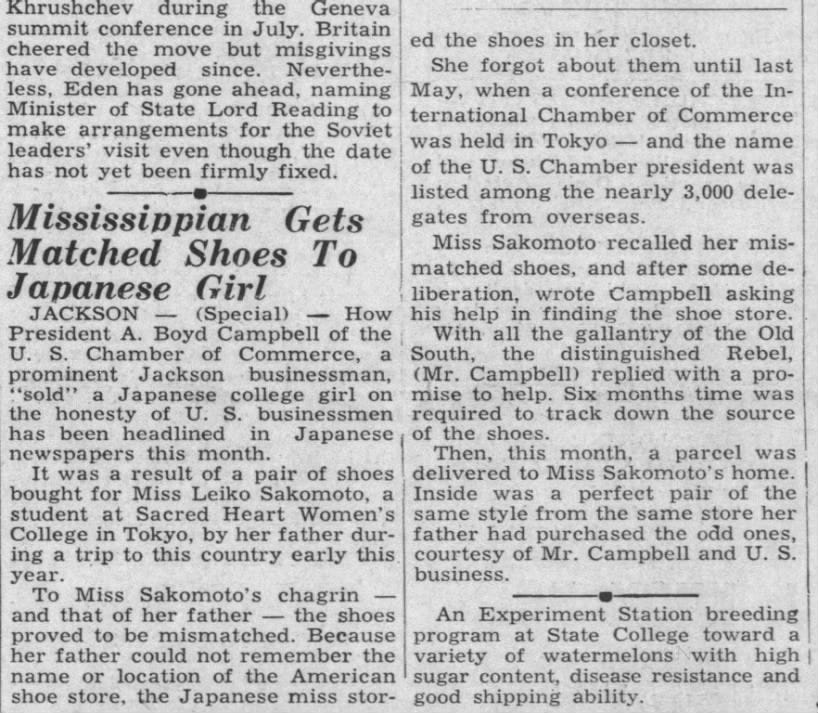
Mississippian Gets Matched Shoes To Japanese Girl JACKSON - (Special)
How President A. Boyd Campbell of the U.S. Chamber of Commerce, a prominent Jackson businessman, "sold" a Japanese college girl on the honesty of U. S. businessmen has been headlined in Japanese newspapers this month.
It was a result of a pair of shoes bought for Miss Leiko Sakomoto, a student at Sacred Heart Women's College in Tokyo, by her father during a trip to this country early this year.
To Miss Sakomoto's chagrin and that of her father - the shoes proved to be mismatched. Because her father could not remember the name or location of the American shoe store, the Japanese miss stored the shoes in her closet.
She forgot about them until last May, when a conference of the International Chamber of Commerce was held in Tokyo - and the name of the U. S. Chamber president was listed among the nearly 3,000 delegates from overseas. Miss Sakomoto recalled her mismatched shoes, and after some deliberation, wrote Campbell asking his help in finding the shoe store.
With all the gallantry of the South, distinguished Rebel, (Mr. Campbell) replied with a promise to help. Six months time was required to track down the source of the shoes.
Then, this month, a parcel was delivered to Miss Sakomoto's home. Inside was a perfect pair of the same style from the same store her father had purchased the odd ones, courtesy of Mr. Campbell and U. S. business.n
Columbian-Progress Thu, Nov 03, 1955 ·Page 10