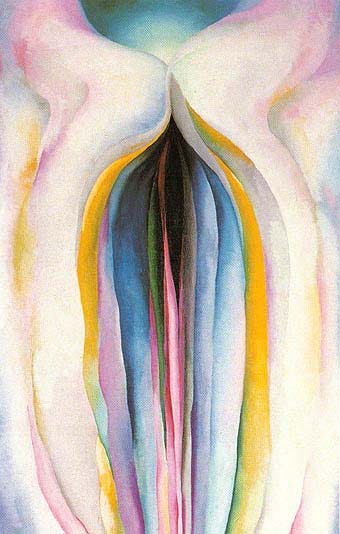
The Vulva Gallery
a discussion of art

An artist follows me who makes life castings of women with mastectomy scars and an entire series on vulvas.
Intellectually, I know how this can be done safely.
Artistically, I’m aware of the statement she’s making. I genuinely am.
However,
Her most recent show was something like three dozen plaster vulva casts staring down on you like predatory birds. That’d make me nervous as hell. Maybe that’s the point.
The point is the female form as the language of art, and finding the line between exploration and exploitation. As an artist, I’m a part of the argument, whether I want to be or not. The sheer number of times I’ve painted or drawn nudes that miraculously have neither nipples nor vaginas suggests I’m pretty nervous about making that statement.
The female form, including the vulva, has been part of the feminist artistic statement for a while now. The aggressive nude is a recurring feature in the Gorilla Gurls’ work, an artist colony that produces only feminist statements of art.
Sometimes people point out that there is no andronist movement in art. Others will point out that most art, including most female nudes, is from the androcentric point of view. I’m probably guilty of that. As an artist and as a person, I’m obsessed with the issue of masculinity, particularly as a statement opposing what I recognize as toxic masculinity. You could say that men who serve because that is the nature of men, as opposed to men who serve to glorify themselves, is the very core of my work. Still, a wall full of plaster vaginas, even as an art installation, makes me nervous.
In college, the Women’s Collective made t-shirts with one of Georgia O’Keeffe’s floral vaginas as an 8 x 10 block of color. While it’s certainly not the totality of her work, O’Keeffe’s floral vaginas are the most famous, and unquestionably the most important.
This happened at a time when I was pretty much sick to death of women. Trying to be honest and vunerable to them was making my life hell. At issue was the pretty obvious fact that I was picking the wrong ones, but, at the time, I convinced myself that the “wrong ones” were the ones who needed a gentleman in their life most of all, if nothing else, so that their opinion of men might change. It didn’t work. I’m aware that there’s a condescending message in that entire idea.
I made a quick painting of a banana between two coconuts with “The Men’s Collective” written under it, and distributed it among friends. We never had t-shirts made, but it was offending people that I wasn’t taking the Women’s Collective seriously. I was taking it seriously, but I was also aware that so much of their focus was on the idea of men as the enemy, a thread that’s still part of feminism.
I’m aware that’s not helpful. I’m also aware of the andromistic nature of the “christian nationalist” movement and the idea that women should return to “traditional roles.” Maybe men are the enemy. They certainly consider feminists the enemy in this movement that, surprisingly, involves a great many women.
I’m aware that issues of dominance and submission make up a fair part of many people’s sexual behavior, but I just don’t participate. Not long ago, a friend encouraged me to write a piece without restrictions. Without restrictions, “How I Paint” came out as a pretty pornographic piece of writing. I suppose that depends on how you define pornographic. I tend to seperate discussions of sexuality from discussions of sexuality from a purient perspective. “How I paint” wasn’t purient. It was, however, very, very naked.
My point with “How I Paint” was to explore issues about the interaction of the artist, the model, the paints, the water, and the brushes. To accomplish this, I compared painting to the oral copulation of a woman in very specific, but not pornographic ways. It switches between paper and flesh often enough, and is timed so that you can’t really say it’s purient, even though it describes an act you can’t do in the hand tools section of Home Depot without getting arrested.
I sent my friend the story by email, saying, “There’s no way I can publish this.” They said it was one of my best. Checkmate. I still get comments about the story. They’re from women. They’re very supportive. I suppose writing from the submissive male perspective on sex saves me the discomfort that a story like that might cause otherwise.
HR Geiger, the Swiss surrealist behind the Alien franchise, also uses the vulva as a principal motif in his work. I looked for an image from his paintings to illustrate this, but honestly, they were all on the edge of getting me banned from Substack.
Geiger says the use of sexuality and sexual organs in his works expresses a “fear of birth.” He really should elaborate on that, but he doesn’t. Indeed, there’s a whole series of his paintings that depict some form of life (usually a skull) emerging from a vaginal canal, done in black ink from his airbrush. Almost none of his work includes color. His paintings are quite large. Some are three meters by six meters. Some are twice that.
As a man, does Geiger’s use of the vulva as part of his artistic language change the rules? Does it change the perspective? How much does the issue of “fear of birth” and “Fear of sexuality” engage this conversation?
I am personally quite terrified of sexual intimacy. I blame Katie’s death for too many things. Katie and I weren’t sexual, although we did talk about kissing a few times. I was against it. I was also made aware of her getting and wearing her first bra—a conversation I never imagined being part of, but was. At thirteen, I should be grateful there was a woman I talked to nearly every night to help me understand the female perspective, if only she lived longer.
I had some pretty serious problems with communication as a child. A profound stutterer and given a mutant-level dyslexia, words are the key to expression, and I couldn’t find them. Instead, I focused on drawing. Maybe having to find alternate avenues of expression yielded a distinct fear of intimacy. I’ve discussed this with psychologists. It was worth $150 for them. It was worth nothing to me. Fortunately, Doug Draper was of such a remarkable mind that I never regretted the money, even though he could never heal me.
I’ve started a series of paintings that’s mostly female nudes. I call it the “unnamed series” because it has a name, just not one I’m willing to share. In it, the point of the nudity is to express vulnerability. I’m pretty careful to obscure the sexual organs (nipples, vulva, etc) because I’m trying to create intimacy without eroticism. I have no idea how successful it is. I suppose it’s one of those things where I’m just gonna keep doing it till it’s out of my system.
I’m not using live models for these paintings. They’re random people on the internet, but they do share features that are an element of what I’m trying to express. Working with live models is never what people think it might be.
I’ve had women say, “paint me like one of your French girls,” from the scene in “Titanic,” but then get mad at me because I’m not paying attention to them while I work. Well, yeah. The point is the work, not service to our relationship. I can do one, or I can do the other. I cannot do both. They usually don’t ask again.
Like most theater people, I have a very geekish attraction to Stephen Sondheim. His play “Sunday in the Park with George” tells the story of Georges Pierre Seurat and the fictional relationship with his mistress named “Dot” (originally played by the great Bernadette Peters. James Lapine, his regular collaborator and librettist, produces some of my favorite lyrics of their entire career.
Seurat is famous for using dots, billions of dots, to express both form, value, contrast, and hue, but only from a distance. The idea of an artist being in love with his brush stroke fascinates me. I didn’t think of that while writing “How I paint.” I was trying to do it as a “stream of consciousness” as requested, and the flexibility of my brush hairs and the flesh of labia folds came out on its own. I have no idea how long I’ve felt that way, but clearly it’s been in my head a while.
The only part I cut was a sentence where I wipe away a badger hair that fell from my brush (as sometimes happens) and brushing away a stray pubic hair from the model’s vulva during cunnilingus. I think it was beautiful, and it helped make my point, but it also embarrassed the crap out of me, and I didn’t want my friend to see it. I suppose they will now.
I’ve had teachers tell me that almost all art is based on the human body. That’s what artists like Rothko and especially Jackson Pollock were trying to escape. One night, I spent hours trying to explain to my wife why Pollock and Rothko were important. She kept saying, “Of course I know how important they are,” and I’m sure she did. She’s a very educated person. I didn’t want her to know how important they are. I wanted her to understand how important they are. My inability to communicate efficiently with my wife is probably why she’s no longer my wife.
Every time I write about art, I’m aware how much it just sounds like self-praise and masturbatory bullshit. I’m aware. I really am. Maybe I should just shut up and paint.