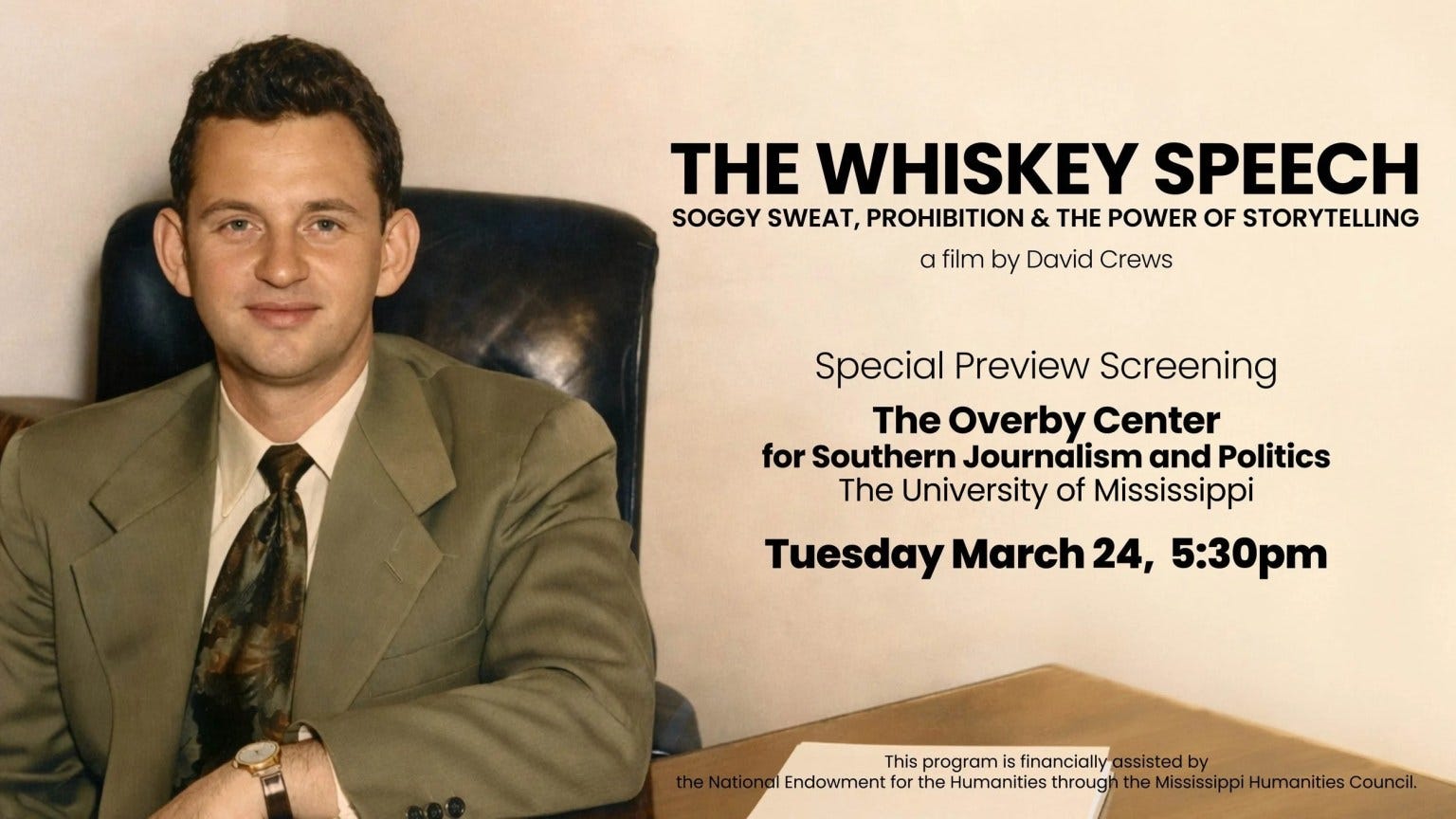
The Whiskey Speech
A film about mississipi

I’m notorious for not taking even the best advice. I have a dear friend who has been giving me advice since we were seven years old. Everyone is fallible, but they’ve managed to be right every.fucking.time. since 1972. I’m not exaggerating.
“The stories you write. Taken together, they form a narrative. It could be a book. It could be a book that tells a different story about Mississippi.”
The narrative they’re talking about is what I call “Mississippi Camelot.” It’s my effort to mythologize a time when Mississippi became more than it was. We’re still in the shadow of Mississippi Camelot, but it’s starting to seem as ancient as the actual Camelot. The narrative that Mississippi is better than what you’ve heard is an expression of my life’s work.
On Sunday, I saw a movie with at least five Mississippi round-table knights in it, and a few more in the audience. I knew Hob Bryan would be there. While I’ve known him most of my life, I haven’t seen him in thirty years. Coming out of the cave and reclaiming my life, it’s only fitting that he’s one of the ones greeting me at the gate. “You’re in my book,” I said, and indeed he is. He’s part of the story about a night at CS’s.
Every good lawyer I know fancies themselves as a better poet. Some are. Wordsmithing is the key to both professions. We use words to make arguments, arguments are the entire point of law, and they’re the skeleton upon which we build stories. There’s an argument in this story, but I won’t do you a disservice and spell it out. Most of my readers are smarter than I am.
“Mythology” is one of our most misunderstood words. It doesn’t mean “untrue.” Myths are stories of the gods (small g), and the Mississippi Whiskey speech is a story of the gods, in a film with actual gods in it.
I’ve been aware of David Crews for a long time, but we’ve only actually met maybe three times. Words are his friends, and he orders them with some skill. That’s a quality all of my friends share. That he would make a film about a cycle of Mississippi Camelot helps my argument.
One of the first faces you see in the film is William Winter, no longer dead, but smiling, teaching, and telling a story, which is my entire memory of the man. Through the film, we get to see Andy Mullins and Dick Molpus, and I laugh to myself, “Is this a movie about the Boys of Spring?”
I was still a teenager when the Boys of Spring were the Knights Errant of Mississippi. Andy Mullins had most recently been my football coach, and before that, he was one of my fraternity brothers at Millsaps College. In a younger form, Floy Holloman used to keep the legends of his college career alive, and keep me fully abreast of which woman I should sell all I own for because they were a pearl of great price. She was right. She was always right.
Coach was once famous for his rust-colored hair. It’s mostly white now, and he spends most of his days herding toe-headed grandchildren. He married one of Clay Lee’s daughters. If I were gonna invent characters in my book, Coach Mullins would be one of them, but he’s real.
Daddy thought Coach would be governor one day and told me so. Instead of Governor, he became the Major Domo for William Winter and decided to “do something” about Mississippi’s teacher shortage. The Boys of Spring were famous for passing the Education Reform Act. Some of them spent their life still fighting that battle. Mississippi’s only hope is in the classroom.
Soggy Sweat’s real name was Noah. “Soggy” is a portmanteau of “Sorgum Top,” a name he was given because, as a young man, his hair resembled the tassel on a cane of sugar. When I was a child, my grandfather would buy sweet sorghum at the farmer’s market, and we’d sit on the dock of his reservoir house, cutting off chunks with a pocket knife, chewing them up, and spitting the fiber we sucked the sweet out of into the poorly named Ross Barnett Reservoir. Daddy and Grandaddy both felt passionately about Ross Barnett as a man. It wasn’t the good kind of passion.
The film makes the point that the now infamous Whiskey Speech was written by a member of the legislature for other members of the legislature as a means of entertainment. David dramatizes it as an actual stump speech at the Neshoba County Fair, which it never was, but it would have been the greatest stump speech there ever was. I haven’t been to the Neshoba County Fair in a while. They say it’s changed. I haven’t.
I have three friends who once paid their bills by writing speeches for candidates. Each was and is a better wordsmith than I can ever hope to be. Talking with one of them the other day, they mentioned how some of what they wrote was too good for a governor of Mississippi. I tend to agree, unless the governor is Bill Winter, who was known to write his own speeches and loved words almost as much as his raven daughters.
Raven women put Boyd in a very particular type of peril. One I’ve never known how to escape from. Sometimes they burned me like driftwood. Sometimes they lifted my soul. You spends your nickle, you takes your chances.
Watching the film, especially the parts with William Winter, I thought to myself, “Now, Brother Winter, you aint sayin’ all you know.” Stories about whiskey are the very soul of Mississippi, and stories about the Great Country Club Raid of 1966 could be its own film.
I’ve tried to write a story about the Country Club Raid since I was fifteen, when I first became aware of it. It’s a deep part of Campbell Family Mythology, and with Warren and Elsie Hood living behind us, and other attendees at my disposal fairly regularly, I spent years trying to get people to go on record and tell me what they know, and other than what was in the paper, nobody would. “Tell him!” Elsie Hood said one night, but nobody told me.
After the raid, Calvin Wells wrote a letter to the editor of the Clarion Ledger (my uncle Tom) saying how the great people of Mississippi should take no inference as to the quality of Warren Hood or any of the other great men questioned for arranging the Carnival ball when the raid took place. Apparently, suggesting that the aforementioned Hood might take a snort once in a while brought the question of his character to the fore. Having witnessed him either taking or refusing to take a drink many times, I have no comment. Neither did Cal.
The beauty of the Whiskey Speech is that Judge Sweat makes an excellent argument for both sides of the third most sensitive subject in Mississippi History, and makes no apology for the dichotomy of the speech. That’s the point.
There are three great questions that divide Mississippi. The first is race. That we have twin museums, one on Mississippi History, and one on Civil Rights History, is a pretty good description of the situation. They’re both part of the same building complex, a project both started by and partially named for William Winter.
It wasn’t entirely the Governor’s idea either. Charlotte Capers and his wife said, “This is how it is,” and that’s how it was, and that’s how it still is in Mississippi. Eudora Welty mighta encouraged it a bit. Miss Eudora was no enemy of whiskey. “How can one fly on only one wing?” She was known to say.
The second great question in Mississippi is about women. Like the “neegras,” women were a restrained and constrained species in Mississippi for a long time. I have opinions on this. Some of you know them. Some of you gave them to me. What I can tell you is that a gentleman is always at the service of a lady, and that includes her precious civil rights. Dieux et les Dames. For God and Women.
Judge Sweat played a principal role in expanding the rights of Women in Mississippi by arranging for them to serve on juries as full citizens, a very important step towards full citizenship for women. In some fights, even small steps are giant leaps.
The third great question in Mississippi is Whiskey. We were the very last state in the Union to legalize Whiskey. Legends and truths about the illegal trade and manufacture of whiskey in Mississippi are some of the best stories about whiskey and about Mississippi.
I’d like to go on record and say that I’m pro whiskey. If I’m gonna say that, I’m morally obligated to say that there was a time when I had to take a deep personal inventory because my drinking was getting way out of hand. I have a generally self-destructive nature. This is how I come to climb the side of buildings and wear snakes around my neck like a scarf. It’s also how I so often followed the wrong woman to Tannhäuser Gate. (That’s an Easter Egg for somebody more important than you—unless it’s you reading this, in which case “Hi. I missed you.”)
Whiskey both ruins lives and bonds souls together. That’s the point of the speech. In Mississippi, every good Christian was against whiskey, but they also drank it. I can tell you, as editor of the Clarion Ledger, Tom Hederman was strongly against whiskey. I can tell you, as his nephew, he was no stranger to whiskey. That’s Mississippi.
My daddy’s sister married a fella from Columbia, Mississippi, who once told me, “You can tell a Baptist from Jackson. They’ll drink right in front of one another.” In my experience, that was pretty true.
My Uncle Levi McCarty (think he might be Scottish) married my Aunt Margaret Flowers. One of the few physicians in Jackson, he was a pillar of the community. He also liked whiskey.
In those days, decent people didn’t drink in Jackson. They crossed the Pearl River Bridge and drank in Rankin County like a good Christian. Levi was a Presbyterian. Presbyterians (on paper) aren’t known for their drinking, but most folks don’t do their drinking on paper.
The Rankin County Gold Coast was known for illegal whiskey, gambling, and professional women. One night, a fella at a Gold Coast establishment said something both incorrect and improper about Uncle Levi’s momma, so he shot him. Being the only physician within driving distance, he treated the gunshot wound he created.
On trial for attempted murder, he was offered a deal. “Go to New Mexico and be the physician to the Indian Reservation there, and we’ll drop the charges.” Now, attempted murder is a state charge, and the reservations would have been a federal matter. How this deal came to be, I have no idea. What I do know is that the McCarty family, except for Ben, who was at Millsaps College, moved to Albuquerque and didn’t return to Mississippi for a long time. When Levi did eventually come back for visits, both the man he shot and his family made threatening noises. He survived the gunfight pretty well, but apparantly he was still sore about it.
I’m not entirely satisfied with the product of the Hollywood system in this current phase. You could say I’m something of a low-level expert on these things. They’re spending billions of dollars making sequels of sequels, and except for “Sinners,” there’s very little meat on the table. Documentary films are getting better and better, though.
The 2024 film “Eudora” is available to stream from the Mississippi Public Broadcasting site. I’m hoping they’ll do the same with “The Whiskey Speech.” The Mississippi Film Society has a pretty great program, sometimes showing at the Mississippi Museum of Art, sometimes at the Two Mississippi Museums, and sometimes at the Capri Theater. I’ll be going to the Capri on Tuesday night for the film “The Murder That Never Happened.”
One of the principal themes in my work is the premise that “There’s more to Mississippi than you’ve been led to believe.” If nothing else, some of the greatest stories in the American Cycle come from Mississippi about Mississippi.
Soggy Sweat is an infinitely better wordsmith than I. I hope you’ll find and take the opportunity to watch the Whiskey Speech. Whether or not you have a whiskey when you watch it, well, that’s just up to you, brother.
“My friends, I had not intended to discuss this controversial subject at this particular time. However, I want you to know that I do not shun controversy. On the contrary, I will take a stand on any issue at any time, regardless of how fraught with controversy it might be. You have asked me how I feel about whiskey. All right, here is how I feel about whiskey.
If when you say “whiskey” you mean the devil’s brew, the poison scourge, the bloody monster, that defiles innocence, dethrones reason, destroys the home, creates misery and poverty, yea, literally takes the bread from the mouths of little children; if you mean the evil drink that topples the Christian man and woman from the pinnacle of righteous, gracious living into the bottomless pit of degradation and despair and shame and helplessness and hopelessness, then certainly I am against it.
But if when you say “whiskey” you mean the oil of conversation, the philosophic wine, the ale that is consumed when good fellows get together, that puts a song in their hearts and laughter on their lips, and the warm glow of contentment in their eyes; if you mean Christmas cheer; if you mean the stimulating drink that puts the spring in the old gentleman’s step on a frosty, crispy morning; if you mean the drink which enables a man to magnify his joy, and his happiness, and to forget, if only for a little while, life’s great tragedies, and heartaches, and sorrows; if you mean that drink, the sale of which pours into our treasuries untold millions of dollars, which are used to provide tender care for our little crippled children, our blind, our deaf, our dumb, our pitiful aged and infirm, to build highways and hospitals and schools, then certainly I am for it.
This is my stand. I will not retreat from it. I will not compromise.”