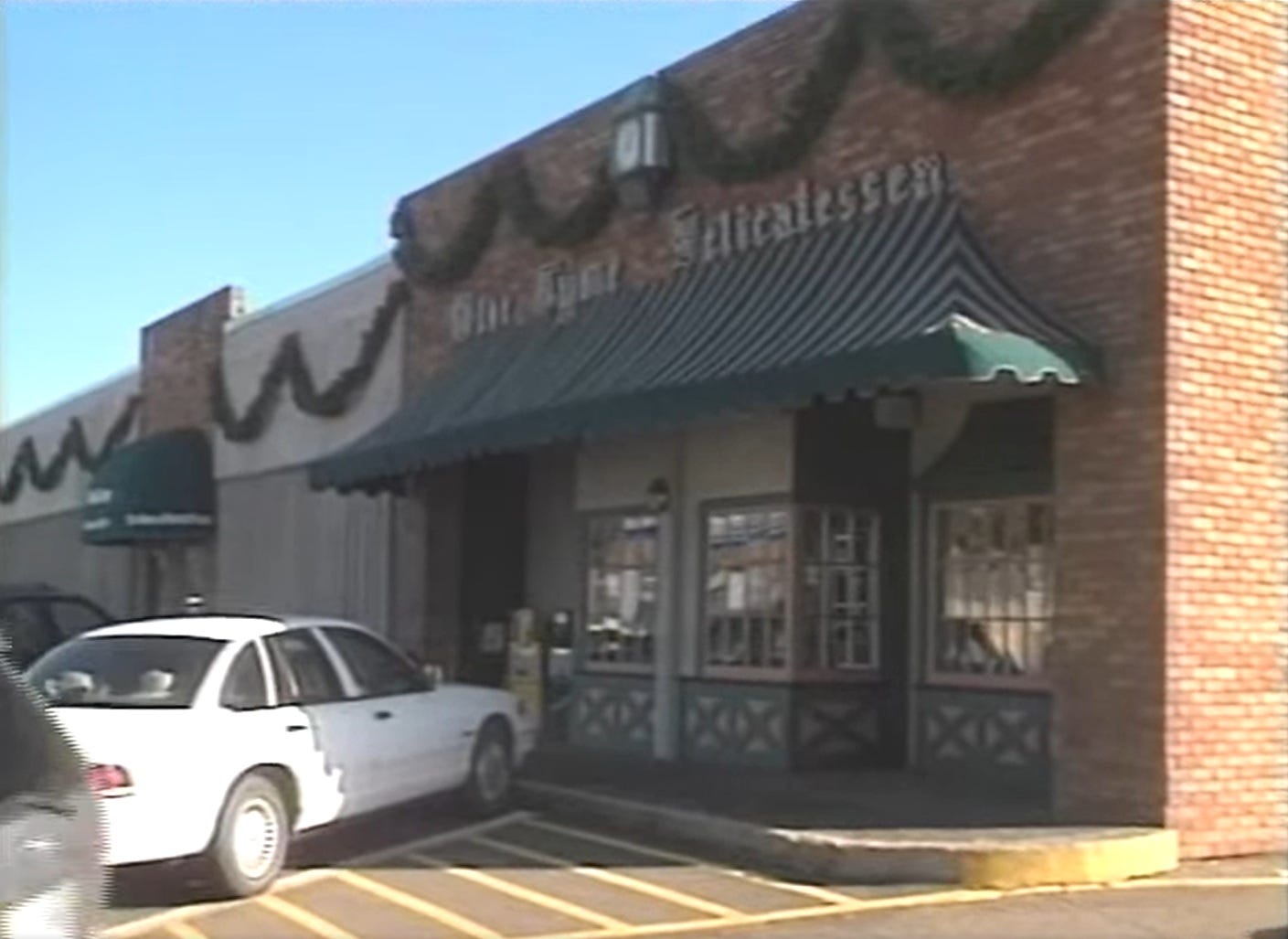
This Aint No Mayberry

Commenting on a photograph of Highland Village in the seventies, a woman said, “Jackson was Mayberry then.” My reply was, “You must have never been there.”
There was never a time when Jackson wasn’t mired in political intrigue, racial unrest, and bullying that, far too often, rose to the level of terrorism and murder. There were, however, times when we handled it better than others. The seventies and eighties were just such a time, although those days had bookends of the same ole, same ole, on both sides.
Calling “Old Tyme Delicatessen” in 1977 an example of Mayberry shows a complete ignorance of the fact that in 1967, the KKK blew up Beth Israel, where Irv and his wife were members.
Mayberry was the invention of Sheldon Leonard Bershad, a second-generation Jewish immigrant who shortened his name to just “Leonard,” and a second-generation Lebanese immigrant named Amos Muzyad Yaqoob Kairouz, who shortened his name to “Danny Thomas.”
Leonard and Thomas made a fortune presenting situation comedies on television that represented America as it wanted to be, not as it actually was. One of their last collaborations was a vehicle for Thomas’s daughter called “That Girl,” which promised to represent first-wave feminism, but, aside from having a job, she was a very conservative fifties girl. A lot of Lebanese girls will claim to be a virgin at thirty-five. If you’re polite, you’ll accept their version, even if they have children.
Given the Americanized name “Margaret Julia”, Margo Thomas was a pretty powerful person, and quite proud of what she contributed, but “That Girl” Ended in 1971, “The Mod Squad” opened in 1968, and “All In The Family” opened the same year “That Girl” closed.
In his many interviews, Andy Griffith recognized that Mayberry didn’t exist in the sixties when his show aired. By his reasoning, Mayberry had modern cars, but was forever stuck in the thirties. He also recognized that a small Southern town could only become all-white through unscrupulous means.
While they resembled each other superficially, the backstage version of Andy Griffith was very much like the backstage version of my dad. They both drank too much, smoked way too much, and they both suffered in their soul the weight of the nation, but resisted every chance to show it.
Marilee Noell worked for Mississippi School Supply forever. Both her husbands came from there. Tall and thin, she spoke like Tennessee Williams might, if he were a woman, or a man in drag. Part of her career involved traveling in Mississippi with my uncle and whispering people’s names in his ear as they approached so he could appear friendlier and more personable than he was. Apparantly, he thought this was worth paying somebody to do.
My dad felt some sorta way about the race situation in Jackson in the sixties. Still in his thirties with incredibly high-pressure positions added to his young career, he didn’t have the luxury of being reckless and firebrand like some of his friends. He found ways to make his feelings known, though.
One day, I was getting a haircut with my grandfather when Orrin Swayze took up the third chair in the four-chair barber shop in the Walthal Hotel.
“Tell Jim (my father) that his new secretary is very tall.” Mr. Swayze said. Living across the street from my grandfather since before the war (the one with Germany), Grandaddy, Mr. Swayze, and Carter O’Ferral spoke in the kind of code that only best friends know.
“She is that,” Grandaddy said. “She’s a teacher, you know?”
“How about that?” Mr. Swayze said. A much-loved black man named John Roy buffed his shoes while the barber shaved him. He knew things he wasn’t going to say.
The way Marilee tells it, Daddy wasn’t going to march or sign something, or do anything to draw attention to himself. His position at the Bank, with Millsaps, and everything else he did didn’t need that kind of heat.
What he did to was to promote a young black secretary to the position of receptionist at Mississippi School Supply Company. While we had a store on Capitol Street, the main operation was on South Street, and everybody in Jackson knew that’s where the meat was stored.
Marilee described the look on people’s faces as they entered Missco and were greeted by a tall, beautiful, impeccably dressed black woman, who spoke better English than they did. In a moment, you could tell who leaned which way, and who just wished they weren’t there at that moment.
I was born into a world of assassinations. Days before my birth, they killed Medgar Evers. Days after my birth, they tried to kill Ed King. Before I could be baptised, they killed the president. These are not events recognized in the Mayberry mythology. Before I was in first grade, somebody tried to blow up Jackson’s synagog. Whatever picturesque memories people have of Jackson, they’ve managed to forget quite a lot.
When the racial balance of Jackson flipped, there was a pound of flesh to be taken. It was painful and as unnecessary as the oppression that preceded it. One of the things we lost in this era was the business corridor on Highway 80. Feeling they could no longer get a decent deal from the new City Council, industry started moving out of Jackson.
Probably the most significant loss of that era was when the deal for Worldcom to take over the Unifirst building was done, financed, planned, it was done, but then the racial strife in the City Council started making demands the company didn’t have time for, so they figured they’d get a fresh start in Clinton.
Now, the Clinton deal didn’t work out because Bernie Ebbers was an idiot, but still. It was an opportunity missed.
I’m not judging anybody for this. After two hundred years of oppression, I understand it, but it wasn’t helpful. We may be turning the corner on that kind of politics. When I look at what’s happening in Jackson now, I feel very confident.
One thing people forget about Jackson for the last fifteen years is that, after Katrina, every poor neighborhood on the Gulf coast moved to Jackson and Memphis. While there is no shame in being poor, it does come with some social complications that lead to a very serious increase in crime.
Republicans love to blame the crime in cities on Democratic policies and ignore the influence of the immense wealth concentration that’s been happening over the last forty years. Maybe when we’re all that poor, they’ll see the light. That’s what happened with both Teddy and Franklin Roosevelt.
Mayberry was a fantasy. A calming cup of soup offered by a Jewish and Lebanese team of comedians that just wanted to make some money so they didn’t have to go back to the hell they came from. Nobody involved in the show will tell you it was like that in reality. By the time I came along, television offered something very different.
The Easter Flood of 1979 exposed the bare bones and rotten pillars holding up Jackson. Barely a teenager, I was big enough to move pianos and pool tables, but too weak to stop all the crying mothers as the homes they built sank in muddy water.
My experience was quite varied. One boy I knew had a mother with “nervous problems.” By “Nervous Problems,” I mean Bipolar 2 and Schizophrenia. Watching her home sink, you could tell where she clawed her own arms bloody in anxiety.
I often tell the story about how one of the kindest people to me was John Palmer, who just wanted us to get his daughters’ clothes. He didn’t care at all for the rest of the house, but he figured his children might feel some sense of normality if they had their normal clothes. Since I knew his daughters, I felt an extra bit of energy in the mission.
What Mr. Palmer didn’t say was that between his house and where we had a flotilla of John Boats was a swimming pool. Unable to see it through the murky water of the Pearl River, I found myself sinking to the bottom of the world in the dark. I managed to find my way back to the light without losing anything in my armload of ladies’ wardrobe, which I delivered to the johnboat, muddy and wet, but intact.
Women who knew me, but I didn’t know, made me coffee and offered me blankets between runs with the johnboat navy. Catching sight of me, Dero Puckett said, “Your momma know you’re here?”
“She’s somewhere,” I said.
“I’ll call her.” She said. “Wear this.” Offering a boy who’s afraid, cold, and wet a dry t-shirt is an unparalleled act of kindness.
I don’t mind that we weren’t Mayberry. Mayberry was a standing set on what had been RKO studios before Lucille Ball and her philandering husband bought it. A lot of the buildings that made up Mayberry became part of Star Trek. You can do that on television.
I don’t make apologies for Jackson, and I don’t make excuses either. We inherited something impossible and fought to make it possible. Sometimes it worked, sometimes it didn’t.
I feel better about what’s happening now than I have in a long time. I think that means something.