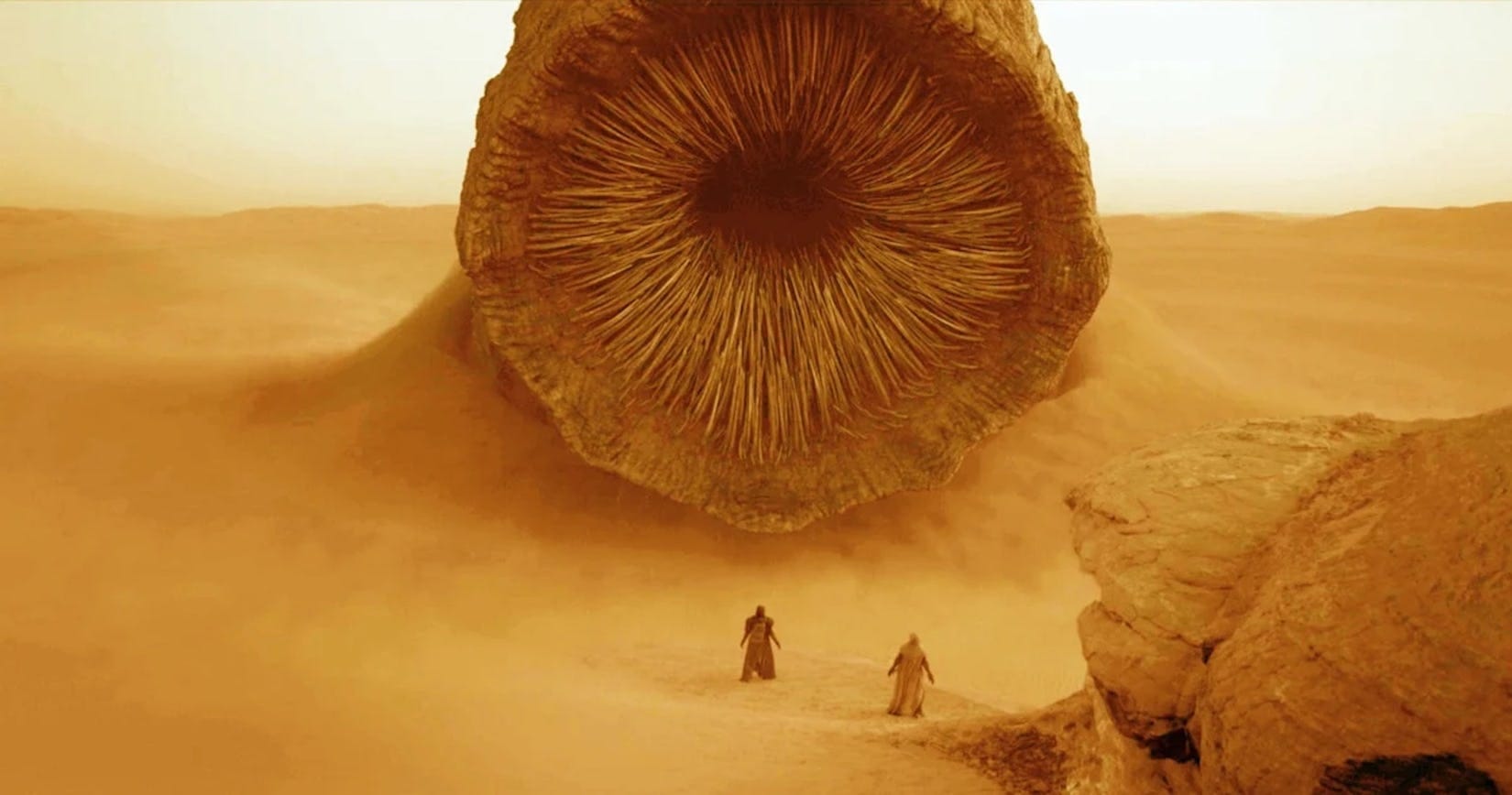
Thumper
Frank Herbert's Dune and the Future of Mississippi

In 1981, I was 18. I could buy beer, which I’d been doing for four years. Inspired by the untimely death of his son, Rabbi Harold Kushner wrote a book titled “When Bad Things Happen To Good People.” It’s been on every Christian book list ever since.
By 1981, after my brother’s illness, my friend Katie’ suicide (which I wasn’t there to stop), and Mr Williams’ suicide (which I was there to stop, but couldnt), learning that my Aunt Babe had been raped as a child, and conflicts with my new headmaster, the idea that suffering did not coordinate with guilt or innocence was starting to weigh on me.
It seemed clear that the wicked suffered with the innocent, and there were times when it seemed like the wicked had the advantage and suffered less.
I was well aware these things weren’t happening to me, but to the people around me. All I had to do was turn away, and none of it could hurt me. I’m not that way, though. The suffering ofothers feels like it’s happening to me. I didn’t mean for that to be. I just sort of noticed it, and noticed it was growing. Seeking to make sense of it all, I focused on the ideas of honor, valiance, and chivalry. I also noticed quite clearly that this was slowly killing me.
I began rationalizing my empathy as either a gift from God or a punishment.
I was born in 1963. In 1965, American Science Fiction author Frank Herbert published the novel “Dune.” A few years older than my father, he, like my father, rode the Rubicon between modernism and postmodernism, with a particular interest in deconstructing the hero myth and the concept of myth itself.
Like Earth, the planet Arrakis was once lush and green, covered with vast oceans. When humans arrived, their corruption and mismanagement turned Dune into a desert planet, with oceans of sand as deep as any ocean of water on Earth. Most of the native species went extinct, but one evolved into the levithan Sandworms, which lived deep in the sand.
A single sandworm was more destructive than an army. They had a secret, too: the sandworm produced the spice, and the spice ran the galaxy and the empire. A group of humans “went native” and began calling themselves Fremen. Though manipulated by the myth-making Bene Gesserit, the Fremen believed in a prophecy that a king would arise and make Arrakis green again.
There were few resources on Arrakis for the Fremen to exploit. The Spice has religious uses, but they couldn’t use it to fold space like the navigators. They did learn, however, to develop the only true power on Arrakis, the Sandworms.
The Fremen invented a device called a “thumper” that they could use to attract the Sandworms up to the surface from their secret and solitary existence in the sand. They called the monsters “Shai-Hulud.” Thumpers made a simple rhythmic sound on the surface that Shai-Hulud found irresistible.
There came a time when Good Ole’ Uncle Boyd almost died. It happened because I tended to the world rather than to me. It developed over many years. My nature always conflicted with my needs, and this was the result.
Instead of dying, I called my sister. She got me in the hospital. Consulting with George Patton, whom I had technically known longer than my sister, he suggested checking Good Ole’ UB into St. Catherine’s, a medical community founded by my father and the Dominican Nuns a generation earlier.
In rehab, the world became about Boyd. Pretty black girls brought me my food and encouraged me. Pretty white girls put me through my paces at their rehabilitation gym. It was slow going at first, but I soon became stronger than the machines they had. It’d been a long time since I used all the weight in the gym.
The front desk made me coffee. If I wanted an aspirin, a nurse would bring it to me. George came to see me once a week. Pretty soon, we quit talking about Boyd and started talking about church. The Methodist Church was splitting again, just like it did when I was a boy, and for many of the same reasons. When I was a child, the question was “Did God love black people?” In rehab, the question became “Does God love gay people?” People will say it wasn’t about that, but it was.
Though I was safe and sound on fifty manicured acres in Madison County, with a lake, because I was slowly coming back into the world, I began investigating the crisis my home and my college were experiencing more and more. Becoming my old self again, I started feeling like myself again. At night, I noticed that someone had hidden my long-forgotten and rusty sword under my mattress, “just in case.”
Across the door to my room hung a painting of Red Gladiolas by Edwina Goodman. Everywhere I went, there were photographs of Sister Josephine Therese Uhll. Somebody was sending me a message. Probably my father, but it could have been Sister Josephine or Bill Goodman.
They checked a fella in down the hall from me. I had known of him for many years, but I didn’t really know him. John Corlew was an old-school Democrat, but his best friend was Trent Lott, an old-school Republican. In his generation, people didn’t pay much attention to their parties; they paid more attention to Mississippi, which was fine by me.
In the modern world, guys younger than me consider party affiliation almost a religious jihad, rather than a means to an end. As you might have guessed, I’m not a fan. Some Tea Party guys did terrible things to my cousin Thad Cochran because they didn’t consider him “Republican Enough.” That’s such a goddamn dangerous slope. The primaries for the next governor’s race in Mississippi promise to be a bloodbath. I’m honestly kind of glad Tate and his family are getting out of it.
John and I began to spend time together. We knew the same people. We remembered the same things. It was still very much an older man and a younger man, but almost like one in my own family. Mississippi is small enough that everybody is family. At least once a week, I’ll tell Little Bird, my protegee, that it blows my mind we’re not actually blood kin.
John’s wife would bring his beautiful dogs to visit him. Just one of them was twice her size, and there were two of them. They were gentle giants, though. John and I would discuss Mississippi while combing our fingers through their mohair coat. Our conversations began changing from what Mississippi was to what Mississippi is.
As my body grew stronger, my mind returned to its natural state. Everybody at St. Catherine’s could see it. John Corlew planted a thumper in the sands of Arrakis. The Shai-Hulud in my soul heard its call.
Thump
Thump
Thump
In Madison, the entire world was about Boyd’s comfort. That started to make me so goddamn uncomfortable. I quit drinking their coffee and started making my own. Their coffee was fine, but I had to be a man again. Coffee is a good place to start. Recently, I secretly sent Little Bird a French Press to make her coffee. She didn’t realize this was a symbol of self-strength, confidence, and renewal. She thought it was just coffee. A brilliant child, I’m determined that she’s twice as strong as I am when it’s done. I owe it to her family.
One day, in the sunlight, Dr. Jeanette Pullen read poems by Emily Dickinson. Dr. Pullen was the founder of the Division of Pediatric Hematology and Oncology at the University of Mississippi Medical Center. Dr. Pullen is a study of quiet strength herself. She saved the lives of dying children. I’ve never had that kind of impact, even once.
After the poetry, petting the Corlew dogs, John and I started talking about Jackson—what I thought, what he thought.
He looked down and scratched the ears of the dog he was loving on, grinned, and looked up almost sheepishly, but knowing something.
“You know, there’s not so much you can do about any of that from here.” He said. That’s when I knew it was time to go home. There’s no sense being strong again if I can’t be me again.
You can’t get into Valhalla unless you die in battle.