What is Camelot?

People who live here will say Eudora Welty’s words best represent us. People who would never live here say William Faulkner’s words best represent us. People who would never visit say Richard Wright’s words best represent us. Understanding Mississippi through our writers is probably the most logical approach. It’s that or our music, which is the same thing, at different levels. I should include painting and pottery in there, too.
This morning, the most beautiful woman in the world informed me that I would be publishing a compilation of my Mississippi stories. I should say, “most beautiful in Mississippi,” but once you win here, you’ve got it covered. Since Gerald Ford was president, I haven’t had much luck resisting her on anything. Smarter than me, and a better wordsmith, I made her promise to help me pick stories. She agreed. Even the most beautiful woman in the world can compromise.
The Faulknerian view of Mississippi became dominant because he became dominant. Eudora Welty was equally as honest, but she wrote about nicer people, gentile people leading lives of quiet desperation. If you ever read “Where Is the Voice Coming From?” written in the wake of Medgar Evers’ murder, you know she could speak with a more vicious, violent voice, but as a lady, she chose not to.
Richard Wright wrote from the perspective of the outcast, the unwanted—a fantastically important voice in the Mississippi story, one that rose in importance when the photographs of Emmit Till were published in Life Magazine.
Tennessee Williams wrote of all the psycho-sexual brokenness that life in Mississippi engendered. While most of his characters left Mississippi, as he did, their wandering naked in new territories exposed even more of what he was trying to say. In his mind, Mississippi was destroying us. Of the four, Williams wrote about the time bordering Faulknerian Mississippi and Mississippi Camelot. The old world is dying. The new world is yet to be born. Now is the time for monsters. A communist wrote that. Enjoy the bone.
Faulkner dominated the era because he wrote with the scope and purpose of Homer, but experimented, at times, with the voice of Joyce. Thanks to Roosevelt and Long, Mississippi was actually on the rise economically during the period Faulkner wrote about, but he wrote about the declevity of the spirit, about the brokenness of the memes we used to construct our culture, and he did it with power.
Returning from World War II and the Korean War, young Mississippians, like most of the country, came home with a new perspective on America. Despite the costs of the war, they had confidence that had never been known in America before. We defeated fascism. We defeated communism. We had the most destructive weapons of war in the history of the world, and we had enough of them to destroy the world many times over.
In the fifties, young men in their thirties, nearly all veterans, began tugging at the reins for their chance to lead the team in Mississippi. They had new energies, new ideas, and a fresh perspective on The Magnolia State.
Although she was of his generation, my Grandmother referred to William Faulkner as “that man.” It seems that, when he invented Temple Drake and Caddy Compson, he offended her ideas about Mississippi Gentility. Eudora Welty sat in front of her at church. They played bridge and went to art lectures together. My grandmother was a voracious reader, but don’t nobody bring her no bad news, or Faulkner novels.
The photographs of Emmitt Till in Life Magazine changed the way the world saw Mississippi, but it changed the way these young men saw their home. The seeds to Camelot were sewn.
The most popular play on Broadway when John Kennedy ran for president was “Camelot” by Lerner and Lowe, based on the book “The Once and Future King” by T.H. White. White’s novels had been wildly popular. The world saw Kennedy as Arthur, his brother as Lancelot, and Jackie as Guinevere. The Richard Burton recording played at presidential events.
The rain may never fall till after sundown
By 8, the morning fog must disappear
In short, there’s simply not
A more congenial spot
For happily-ever-aftering
Than here in Camelot
The unbridled optimism of Camelot was brought short by a bullet, then another, then another, then another. One by one, our heroes were being systematically executed. Now was the time for monsters.
In Mississippi, the seeds of a new world were planted. Second-generation leaders were starting to take their positions, and new leaders were emerging from the Mississippi pine forests. The battle for Oxford yielded a new generation of Ole Miss Alumni who sought a different valuation and reputation for their Alma Mater. Camelot was pushing to be born.
The last great battle between the old world and the new was the Private School Crisis of 1970. I’m of the opinion that the new world lost to the old world then. To keep our schools white, Mississippi grew literally dozens of private schools in ten months. It wasn’t our finest hour, but this last push of the old guard exhausted much of their energies. For example, the Mississippi Citizens’ Council was eight years from folding in on itself. Questions sometimes arise as to what happened to the money in the bank account—I simply do not care. I hope he stole every last cent.
Mississippi had new ideas about business as well. Old Capitol Street firms like Primos and McCraes branched out to the suburbs. Our two flagship banks were at war on paper, but in practice, it was a white horse and a black horse, both hitched to the same cart, and pulling with all their might.
Dixiecrats, the bastions of Jim Crow, were dying. New Democrats and New Republicans were emerging. At first, they were both moderates. That would change over time. I wish it hadn’t.
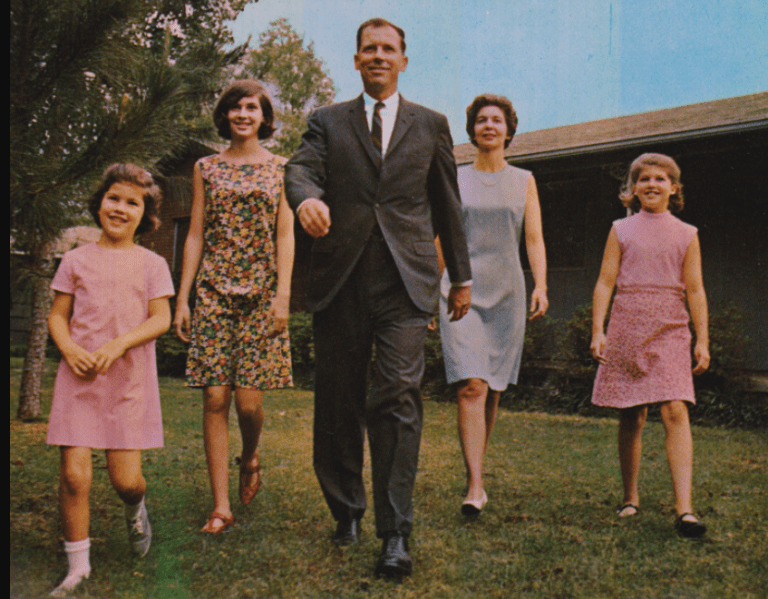
William and Elise Winter had the ability to draw different factions together. He’s rumored to have brought legal whiskey to Mississippi despite the Dixie Mafia’s attempts to stop it. What you believe of that story is your business. I will say that getting a drink at a place like Scrooges and having to cross the Woodrow Wilson bridge into the wilds of Flowood made central Mississippi a much more civilized place.
The Winters were a new face for Mississippi. A far cry from his predecessor, who got shot by his wife in the Governor’s Mansion for philandering. That’s not the official story, of course, but if you ever saw her official portrait, you’d believe it. Cliff Finch was hardly the first or the last Mississippi Governor to be guilty of philandering, but he was the only one so far to get shot over it. If Tate ever cheats on his wife, I’ll help her shoot him. (It’s a joke FBI!)
Elise Winter was a lady. She took it on herself to restore the ancient Governor’s mansion. There are stories about what she found. Lots of them. Eudora Welty was invited to the mansion and sat at the table with the Governor. They were genuine friends and remained so for the rest of their lives.
Jim Crow wasn’t dead in Mississippi, but he sure was sick. Talk of a new flag emerged, and discussions about rebranding the University of Mississippi were a hot topic, largely because many alumni agreed with the idea. Little Millsaps College reached peak enrollment by developing two programs nobody thought we could: the Heritage freshman initiative and the Else School of Management.
Camelot was alive. It was tangible. It became my life. It was the song my father was singing at the very moment when he died.
I’ve written about the end of Camelot. I wrote about it last night. It ended because it’s an idea, and ideas are made of gossamer and ether. They can’t stand the brutality of the real world.
Though he never uses the phrase, John Grisham writes about the Mississippi Camelot era. It’s when he was a young associate at a big firm and serving in the Mississippi House, eating pimento and cheese crackers at the Sun and Sand. For a lot of guys his age, that’s all they could afford, but they came to Jackson to make a difference in the State Capitol, and they did.
Willie Morris writes about the twilight of the old world and the birth of the new, much like Harper Lee did with “To Kill a Mockingbird.” Grisham reformed the Mockingbird story, draped in the cloth of Mississippi Camelot, creating a new perspective in “A Time To Kill.”
Every young lawyer I knew in the Camelot era saw something of Atticus Finch in themselves. Herodes Atticus was a Greek Philosopher in the Roman Era. The South has always tried to paint itself in classical colors. Much of it fits comfortably.
I’m aware that much of my writing is myth-building. People need myths. Myths are the building blocks of culture. Concerned that the Romans had stolen the myths of the British People, J.R.R. Tolkien set out to create a new mythology to replace what was lost. “The Lord of the Rings” was the result.
While much of Tolkien’s world is taken from the Norse, you cannot miss the Irish Elves or the Scottish Dwarves.
I won’t apologize for painting the Camelot period as better or more interesting than it really was. I’m not a historian. I’m a storyteller. This is my story. If you live here, this is your story.
Once, upon a time, there was a land and a people. There was blood on the land, but hope in the heart of the people…
Camelot is the story of a Mississippi that tried to become something different than what it was. Some say we flew too close to the sun. Some say it was a fool’s errand to begin with. I say, there should always be a house on the hill, even if we can never reach it. A man’s reach should exceed his grasp, else what’s a heaven for?