Writing Letters

“When you finish your homework, I want you to write a letter thanking Aunt Jo for the Christmas present.”
“I don’t know why I have to write letters. Nobody can read ‘em.”
The thing my Momma knew, that I did not, was that the act of writing letters means something entirely different from the content of the letters. Aunt Jo didn’t want to read what I wrote; she wanted connectivity to my little heart and my rapidly growing fingers.
Every child has confidence problems. Giving them things to do at home that they’re really not very good at probably makes it worse. My mother and I used to have great battles over homework. She thought I was disobedient. I thought I was stupid. And so it goes.
The teacher said, “I dunno, get him a typewriter, maybe?” Sometimes the right idea comes when you put the least thought into it. Walking fifty yards to the Education Center three days a week, a lady with a mid-sixties haircut and a mid-sixties hemline taught me to ride IBM Selectric III typewriters like proud, wild stallions. Though I never mentioned it, her dresses were becoming a problem. “I’m old enough to where I notice these things, lady. Don’t distract me.” In retrospect, she was probably twenty-four at the time. I’m seven thousand, four hundred and twenty-three years old now. A woman in a short skirt at twenty-four seems like a newborn.
The late fifties and early sixties were a terrible time to be born in Mississippi. We didn’t know it, but men and women with swords began chasing the dragons from the land. We buried one last week. You couldn’t see it, but they laid his sword across his chest. In the seventies, you could see sunlight; by the eighties, Camelot was in sight, but we called it “The Bold New City.”
Ronald Reagan talked about “The Shining City on a Hill.” Yeah, I lived there. Obviously, we didn’t start there, but we were getting there. Sometimes, I’m criticized for infantilizing Mississippi’s troubled history. Jesus said, “Suffer the little children to come unto me.” For little children who suffer, that’s such an important message. I never claim to be a believer. I believe I have to be honest. I’m an agnostic. I don’t think I can evolve beyond that. I’d love to know the truth about God, but I don’t think I can contain it. If I can write so that children understand what I mean, then I’ve succeeded.
Ugly boys can get around town pretty good.
“Don’t say you’re ugly.”
“Oh, hey. I didn’t know you were reading. Sorry. I’ll be more careful.”
“You better.”
As the troubled seventies died, and the bright light of the eighties were ahead, God himself sent a flood into my city. He sent it on Easter. My childhood friends lost their homes. They called Bessie Speed, Vesh, because her youngest child couldn’t say “Bessie” like his father did. That’s similar to how I ended up being Bird. I never thought I’d see Vesh cry. I never wanted to. She was so beautiful, but cry she did. Can you blame her?
When it was over, John Palmer wrote me a letter.
“Dear Boyd,
Thank you for rescuing my daughter’s wardrobe from my possibly snake and alligator-infested home.”
He failed to mention the neighbor’s pool that swallowed me whole because I couldn’t see it through the murky Pearl River floodwaters.
Except for Robert Wingate, who’s also my cousin, I never got a letter from one of Daddy’s friends before. In his house, I didn’t see any signs of alligators or snakes, but then you wouldn’t, would you, not until...CHOMP!
I’ve written about the Easter Flood before. It was a fixed moment in history. It changed me. On my typewriter, I wrote a letter to Dale Danks, our mayor, thanking him for the job he did during the flood. I was all of sixteen.
Sixteen wasn’t a banner year for Uncle Boyd. Someone I loved tried to kill me. I saw the girl I loved at the movies with another boy. Fuck that guy. Terrible movie.
That’s not fair. He’s a good guy. I knew that. Were he not a good guy, he might not have made it to see the movie’s end alive. Terrible movie though. I know so many better ones.
Thirty-two years later, I had drinks with Dale, our mayor, at Scrooges. I might have had drinks at Scrooges before. Maybe a few thousand drinks. He reminded me of the letter. My mayor, Duke of the shining city on the hill, knew me by my name. I think he knew they called me “Bird” but he never said so himself.
At the funeral for TW Lewis, John Woodward called me “Bird.” Goddamnit. I wanted to kiss him. My sister has evolved to calling me UB for “Uncle Boyd” but who knows, it might be “Ugly Bird.”
Don’t say you’re ugly.
Sorry.
Once, I handwrote a letter to Fishbait Miller because he was on television. Miller was from Pascagoula. For decades, he served as the Doorkeeper for the US House of Representatives. In 1997, the job of the doorkeeper was transferred to the Sergeant at Arms. During the events of January Sixth, William J. Walker, a retired general from Chicago, was Sergeant at Arms. He was replaced by William McFarland of Maryland, the first person with actual law enforcement credentials to ever hold the job. I guess the job description changed.
My father had my letter to Fishbait Miller typed out by his secretary, Debbie Tullos, and I signed it. Debbie ended up as the president of the School Book Supply Company in Louisiana. Daddy was sometimes criticized for giving women “more power than they can handle.” You can imagine how that went over.
I signed the letter, and off it went. Debbie might have helped with the grammar. A few weeks later, I got a thick manila envelope filled with all sorts of printed material about the US Capitol. Since I said I had a little sister, she got one too. Being maybe five at the time, she was pretty bewildered by it.
While visiting Washington, my father and brothers visited the Smithsonian Aerospace Museum, while my mother and I toured the US Capitol, led by Fishbait Miller, pulling my baby sister along behind us as fast as her little legs would go. I cannot remember a time when I looked upon even a photograph of the Capitol without feeling the kindness of Fishbait Miller. All because a little boy wrote a letter. To be fair, he had help. Debbie died a few years ago. I’m not at all clear on how I got this old.
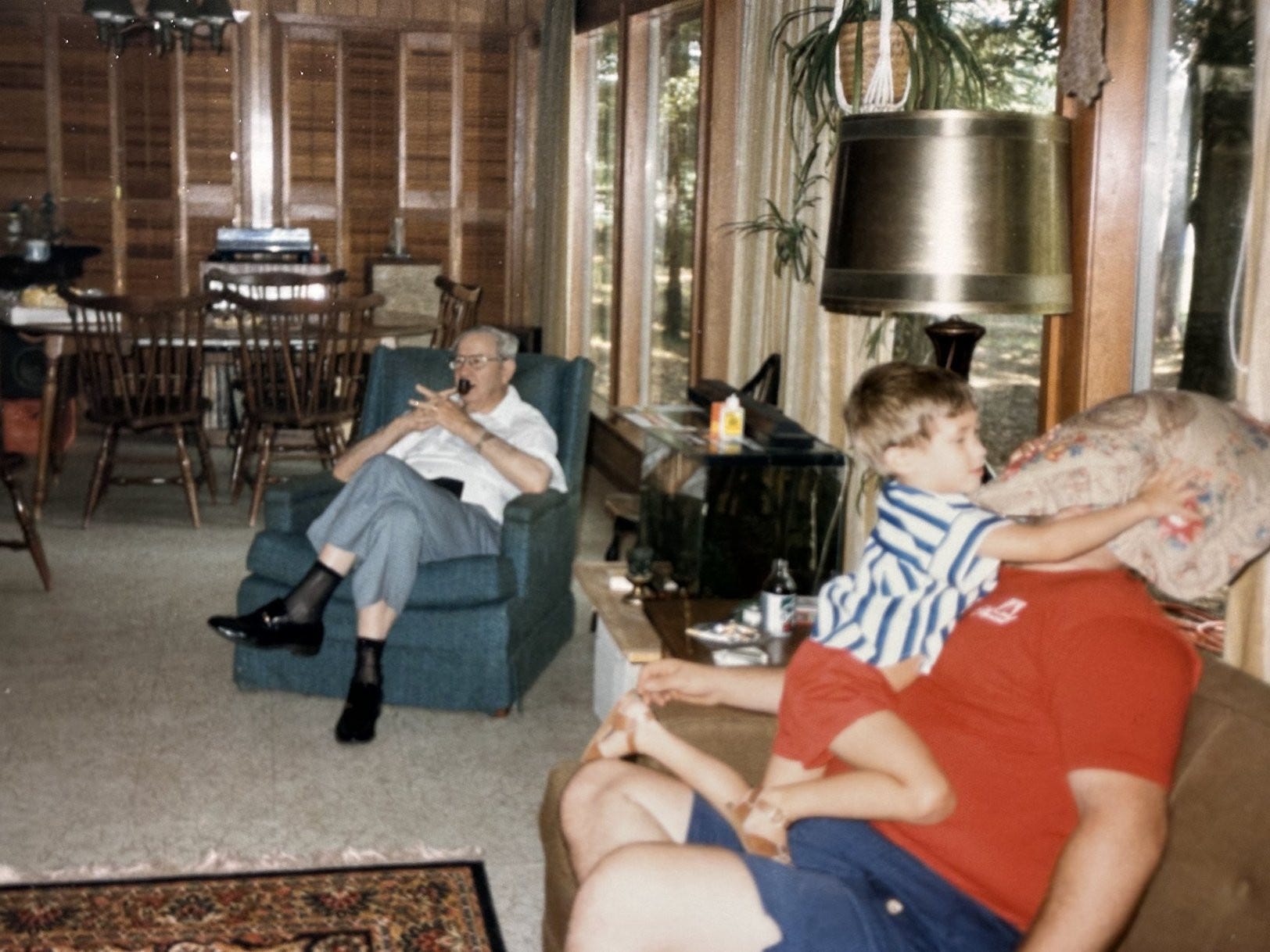
When my Grandmother, whom we called Bubba, who was absolutely not a Bubba, moved to St. Catherine’s, she gave me the end table that always sat next to Grandaddy’s teal green leather recliner. They had an Art Deco house in Belhaven. Teal green was big in the Jazz Age. Grandaddy bought Bubba a great big color television and had the middle of his bookshelves rebuilt to hold it in the middle. She had a Queen Ann wing back chair where she watched PBS. Grandaddy had a teal-green leather recliner with a small, portable black-and-white TV on top and an earpiece, so he could watch sports while my grandmother improved her mind. My grandfather improved his mind by reading anything he could find. He loved Louis Grizzard.
I don’t know whether Bubba never checked the drawers in the end table or decided to leave it as it was. In my home, I examined the drawers. Besides a dozen spent Bic lighters, I found many letters. My grandfather smoked a pipe and spent butane fumes from Bic lighters. Bruno Bich was a family friend. We liked to talk about sailing. Like my friend and skipper, named Boudreaux, Mr. Bich (not Bic) told me about not sailing in the shadow of someone else’s wind. Good advice. His father developed a thick ink that would work with rolling-ball pens. Bruno made it disposable. You’ve, no doubt, held thousands of Bic pens.
Inside the drawers were some of the practical jokes he played on us as kids, including a box of rattlesnake eggs and stacks and stacks of letters and cards from grandchildren. One was a birthday card signed by four kids named Campbell. You could tell which one was mine because you could read the other three.
I used to say, “If I ever get famous, nobody will want my autograph because they can’t read it.” “You’d make a great doctor,” Doug said, referencing the troubles pharmacists often have reading prescriptions. There was a time when a note on a doctor’s stationery, under his signature, could get you the most dangerous drugs in the country. They never had much problem with fraud because you can’t fake a doctor’s autograph. It’s too complicated.
I used to write to all the famous monsters. Sometimes they wrote back. Sometimes they didn’t. Sometimes they’d send an eight-by-ten photograph with their signature on it. Sometimes you could tell the signature was part of the photograph. If they signed it separately, you could tell when you held the photograph up sideways to the light.
For an ugly boy, I wrote to a lot of beautiful women.
“Don’t say you’re ugly.”
“Sorry. I’m working on it.”
I wrote Fay Wray about how much I loved King Kong several times. She never wrote back. One day, I knew her birthday was coming up. A friend had given me the address of what turned out to be her son’s music store. For her birthday, I sent her a signed copy of “The Optimist Daughter” that I picked up at Cherokee Books, and wrote to her about her first major film role in “The Wedding March,” but never mentioned King Kong.
Instead of writing back. I got a phone call. “Boyd, this is Fay Wray.”
“Oh.”
I sat down. In all of our talks, I never once mentioned King Kong.
Eudora Welty lived here. She went to my church, and she was at Millsaps all the time, but I never once asked for her autograph. I never asked Fay either, although she once sent me a yellow index card with her autograph. I learned that writing autographs ahead of time on good days so she wouldn’t have to on bad days was part of how she managed her arthritis. It hangs on my wall. I learned that she kept a stack of them. Still, it touched her hand, and I touched her hand. It stays on the wall.
This morning, I wrote a letter to somebody Important. More important than you. Sorry, but it’s true. It’s true, unless, of course, this is you reading. In that case, “Hi. You look nice.” That’s kind of a lie. I have no idea what you’re wearing, but I know it’s nice all the same.
I didn’t have to write my friend, but I needed to. I’ve needed to for ten thousand years. The great irony of our ancient history is how we both ended up loving a third person far more than we ever loved each other. I often treat the third person like she’s seven years old. I do that because, when she actually was seven, Uncle Boyd was nowhere to be seen. That was my mistake. She’s given me a second chance. I won’t fail this time. Where would men be if women didn’t forgive us?
One day, she’ll be here, and Uncle Boyd won’t. I make the Little Bird a part of my stories so that I’ll never abandon her again, even if my body does.
Maybe I’m not so ugly after all.
Many times, the only way I can say what I need to say is to write it in a letter. For some people, you can fill many libraries with what I need to tell them. There may not be enough paper to print it all out.
When I was little, I would end my letters saying,
Your friend,
Boyd
Because that’s how they taught us in school. More than that, though, if I wrote a letter, I wanted to be their friend.
Writing to my friend today, I just said,
Always,
B